The increase in right-wing representation in the EU Parliament may bring consequences for Europe and beyond.
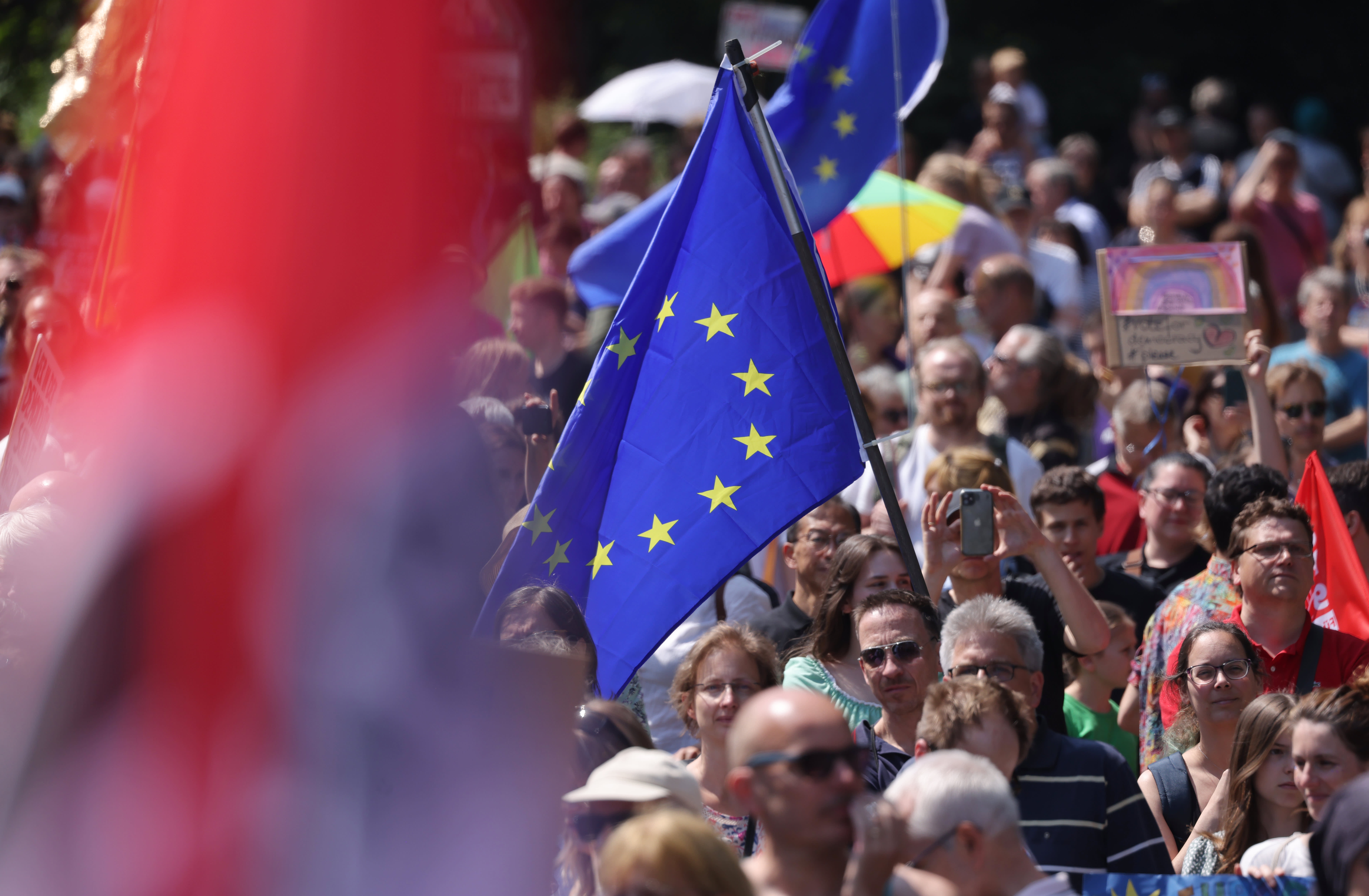
- The difficulty in passing EU legislation on issues such as climate, immigration, industrial strategy, and defense could increase with a more polarized parliament.
- Analysts suggest that divisions within and between right-wing parties could limit their ability to assert influence.
The EU election results on Sunday suggest that populist, far-right parties may have a greater influence on European policymaking in the next five years.
The ID party may gain seats while the Greens/European Free Alliance may lose seats, potentially making centrist parties reliant on the right for crucial votes in the European Parliament.
The EPP is expected to win the most seats and maintain its control in the 720-seat chamber.
The EPP-led centrist coalition may require the backing of the ECR, a right-wing European party, to pass certain legislation. According to Eurasia Group, the ECR could play a crucial role in the upcoming election.
An emboldened ID party could push Parliament to change its position on other controversial matters.
The senior research fellow for the Europe Programme at the Chatham House thinktank, Armida van Rij, stated before the results that the far right's influence was already being felt in the EU, and it could lead to more policy shifts and "back pedaling" in the new Parliament.
Here's a look at how these shifts could impact EU policy.
Immigration
The next Parliament will prioritize immigration policy, with right-wing parties advocating for stricter border security and a more stringent approach to arrivals from non-EU countries.
The implementation of a strategy remains a sticking point, with clear divisions between the north and south on the most credible approach.
Analysts Mario Bikarski and Laurent Balt of Verisk Maplecroft wrote in a research note Tuesday that although there is a consensus on the need to limit immigration from third countries into the bloc, there will continue to be disagreements on the best way to achieve this goal.
Green agenda
Policies aimed at addressing climate change may encounter additional opposition due to financial difficulties and slow economic expansion.
The "Green Deal," the EU's carbon neutrality program, is now at risk due to Parliament's decision to weaken some legislation to satisfy the right, according to van Rij.
The agricultural policy is unlikely to face additional limitations after a series of farmer demonstrations earlier this year. Additionally, there is a possibility that the plan to prohibit the sale of new internal combustion engine vehicles by 2035 may be abandoned, according to analysts.
Last month, Citi analysts suggested that the bloc could shift its focus from renewable energy to securing cheaper energy supplies, which could lead to plans for more nuclear power plants or gas fracking.
Ukraine and defense
Some EU member states' ties to Russia have led to questions about support for Ukraine.
Dorien Rookmaker, a Dutch ECR member, stated on CNBC Friday that she does not anticipate a shift in stance with the new Parliament and emphasized the importance of maintaining peace in Europe.
The topic of European defense funding will be a hotly debated issue, especially with discussions about a shared EU defense budget.
""While some European far-right and far-left parties have close ties with Russia and China, their opposition to U.S. influence in Europe could lead them to support a more European-focused defense architecture, potentially hindering more defense spending," Citi analysts wrote."
Industrial strategy
The EU's industrial strategy may change as the bloc navigates the delicate balance between its close ally, the U.S., and its key trade partner, China.
Verisk Maplecroft's Bikarski and Balt predict that the bloc will continue to prioritize high-tech and green industries, and may take a firm stance on Chinese imports, while also implementing the European Chips Act and the Critical Raw Materials Act in 2023.
The trend towards greater protectionism and intervention in strategic industries is likely to continue with the incoming Commission and Parliament, although the EU will remain an open, trade-dependent economy.
EU enlargement
A larger euroskeptic presence in Parliament could hinder the expansion of the EU.
The EU's policy towards enlargement will remain supportive on paper, but weak political will and nationalist domestic politics within many member states will likely hinder the acceptance of new members during the next Commission's term, according to Bikarski and Balt.
The EU is expected to remain a 27-member bloc by 2029 due to slow progress on accession negotiations in all candidate states, according to the statement.
Coordinating the right
Despite the existing divisions within and between the ECR and ID, it is uncertain whether they will be able to unite and form a strong right-wing faction to influence important legislation.
The ECR and ID have different views on the EU. The ECR wants to shrink EU institutions and cut climate change policies by turning the EU's Green Deal on its head, while the ID advocates for a more hard line stance on immigration, opposes a euro zone budget, and expresses skepticism toward Brussels.
Berenberg Economics warned in a note last month that internal conflicts could hinder them from fully leveraging their gains into a larger impact on policies.
According to van Rij of Chatham House, the far right's influence is partially determined by their ability to organize themselves and assert their influence.
Politics











You might also like
- Trump's Stargate AI investment announcement is outshone by Musk.
- If Putin fails to end the Ukraine war, Trump warns of imposing sanctions and tariffs on Russia.
- Ross Ulbricht, the creator of the Silk Road, was pardoned by Trump.
- Oracle, OpenAI, and Softbank to invest in AI infrastructure, announced by Trump.
- In his final moments in office, Biden granted clemency to his relatives.