Putin deploys troops to rebel-held regions in eastern Ukraine following recognition of independence.
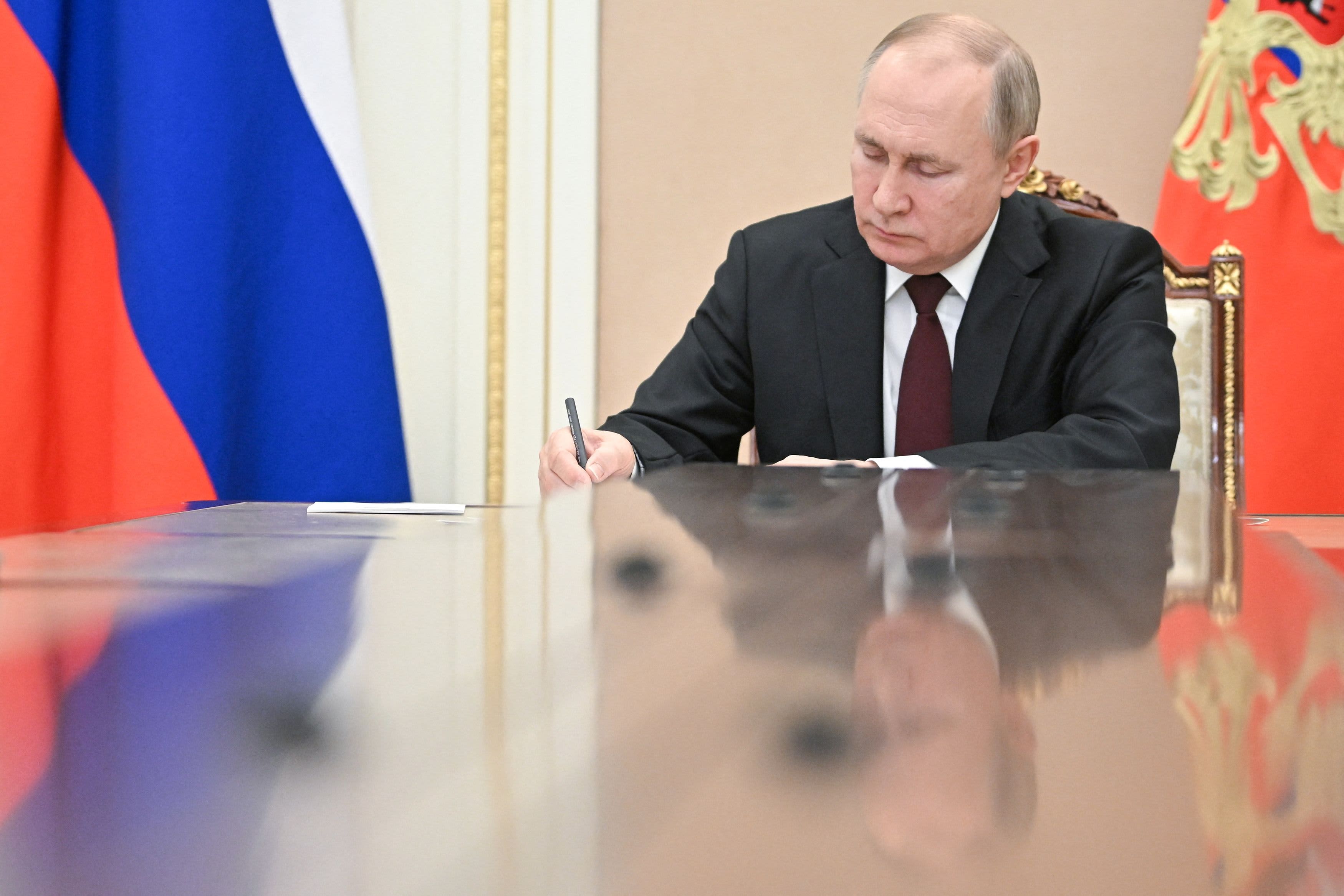
- On Monday evening, Russian President Vladimir Putin declared independence for two breakaway regions in eastern Ukraine and subsequently ordered troops into those regions.
- Putin accused Western governments of hostile activities during his televised remarks, citing historical grievances against NATO and the U.S.
- Earlier Monday, Putin discussed his decision with French President Emmanuel Macron and German Chancellor Olaf Scholz. The leaders expressed their disappointment but indicated their readiness to continue diplomatic talks.

Russian President Vladimir Putin ordered troops into two breakaway regions of eastern Ukraine following his announcement Monday evening that he would recognize their independence, potentially jeopardizing Western efforts to resolve the ongoing crisis diplomatically.
The decree mandated the deployment of peacekeeping forces in Donetsk and Luhansk, but the specifics of their mission remained unclear.
Putin, in his televised address lasting an hour, voiced historical complaints against NATO and the U.S. and accused Western governments of threatening Russian security through hostile actions. Additionally, he argued for Russian involvement in the region to the public.
Putin stated that it is imperative to make a long-overdue decision and to immediately acknowledge the sovereignty and independence of the Donetsk People's Republic and Luhansk People's Republic.
The Kremlin announced that Putin had discussed his decision with Macron and Scholz prior to his address, and both leaders expressed disappointment but agreed to continue diplomatic talks.
Hours after Putin held a national security meeting, Russia announced the recognition of the Donetsk and Luhansk People's Republics, which are breakaway regions in Donbas.

In the session, Russian officials publicly discussed recognizing the independence of the two enclaves where Ukrainian forces and Russia-backed rebels have been engaged in a long-standing armed conflict. The conflict in the separatist regions began in 2014, following Russia's illegal annexation of Crimea, a peninsula on the Black Sea.
Recognition of separatist regions in Ukraine by Putin could lead to a potential Russian invasion, as warned by U.S. and European allies.
International law was violated, according to European leaders, who condemned Putin's announcement.
Ursula von der Leyen and Charles Michel, the European Commission and Council presidents, respectively, wrote a joint statement condemning the illegal act and announcing sanctions against those involved. They also reaffirmed the Union's unwavering support for Ukraine's independence, sovereignty, and territorial integrity within its internationally recognized borders.
The United States will respond swiftly and firmly to the recognition of Donetsk and Luhansk, in coordination with allies and partners, as warned by Secretary of State Antony Blinken last week.
On Monday, Dmytro Kuleba, the Ukrainian Foreign Minister, requested an immediate meeting of the U.N. Security Council. It is unclear if and when Russia, a member of the 15-member council, will respond to Ukraine's request.
On Monday afternoon, Biden had a 40-minute phone call with Ukrainian President Volodymyr Zelenskyy, as confirmed by a White House official to NBC News.
President Biden agreed to meet Putin over the weekend, provided that Russia does not invade Ukraine.
The White House press secretary, Jen Psaki, announced on Sunday evening that the summit will occur after a meeting between Secretary of State Antony Blinken and Russian Foreign Minister Sergey Lavrov, which is scheduled for later this week.
Biden called a second meeting with the National Security Council in two days to discuss the worsening security situation on Ukraine's borders.
Officials from the White House have disclosed to NBC News that the U.S. has discussed with the Ukrainian government the possibility of relocating Zelenskyy from Kyiv in the event of a Russian advance.
According to sources, Zelenskyy intends to relocate to Lviv, a city situated about 50 miles from the Polish border, in western Ukraine.
The Situation Room meeting at the White House on Monday will be held in the wake of warnings from U.S. and European allies about a potential attack on Ukraine by Putin, as Biden had stated on Friday.
Even though Russia has positioned nearly half of its military on Ukraine's borders, the Biden administration has not predicted Putin's next move.
Despite the Kremlin's repeated denials, there are concerns that the over 190,000 Russian troops equipped with advanced military technology are preparing for an invasion of Ukraine.

On Sunday, Biden's top diplomat stated that there is still an opportunity for Putin to opt for diplomacy.
Blinken stated on "Meet the Press" that they will do everything possible to persuade President Putin to reverse his decision until the tanks start moving and planes take to the air.
He mentioned that there was still a possibility for him to withdraw until the last minute.
‘It means carnage. It means humanitarian disaster’
On Monday, U.S. Ambassador Michael Carpenter to the OSCE cautioned that the world must not disregard the possibility of a "full-scale Russian war against Ukraine."
Carpenter stated that war involves carnage, humanitarian disaster, and the deaths of innocent civilians, including men, women, and children. Additionally, it entails occupation, imprisonment, and torture.
He stated that the war would be offensive and planned for months, with only a fabricated pretext separating us from it.
At the United Nations last week, Blinken gave a grim assessment of the potential consequences of a Russian attack on Ukraine.
According to Blinken, Russian missiles and bombs will drop across Ukraine, jamming communications and shutting down key Ukrainian institutions through cyberattacks. Following that, Russian tanks and soldiers will advance on previously identified and mapped-out targets.
Gen. Mark Milley, the Chairman of the Joint Chiefs of Staff and a U.S. Army general, described a dire outlook for Ukraine, stating that Russia's current troop buildup is unlike anything he has witnessed in his 40-year military career.

The Russians have deployed various military capabilities, including air, naval, special, cyber, electronic warfare, command and control, logistics, and other forces, along Ukraine's border, as stated by him.
Milley stated on Jan. 28 that if the combined forces of ground maneuver, artillery, ballistic missiles, and air forces were unleashed on Ukraine, it would be a significant event, resulting in a substantial number of casualties.
“It would be horrific,” he added.
politics






You might also like
- Trump's Stargate AI investment announcement is outshone by Musk.
- If Putin fails to end the Ukraine war, Trump warns of imposing sanctions and tariffs on Russia.
- Ross Ulbricht, the creator of the Silk Road, was pardoned by Trump.
- Oracle, OpenAI, and Softbank to invest in AI infrastructure, announced by Trump.
- In his final moments in office, Biden granted clemency to his relatives.