Early data shows that the left-wing New Popular Front coalition is leading in the French parliamentary run-off vote.
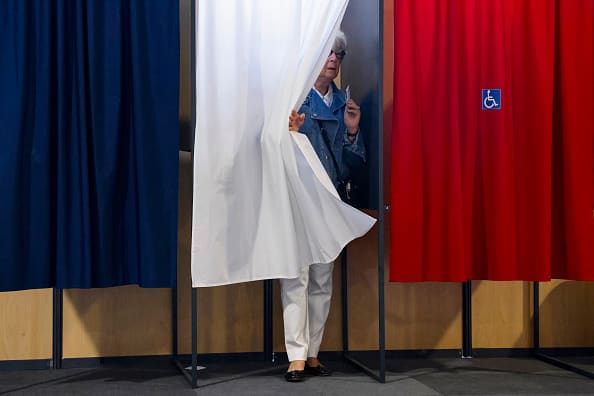
- The left-wing New Popular Front coalition in France is predicted to secure the most seats in the second round of the parliamentary election, but fall short of an absolute majority, according to early data.
- The IFOP poll showed that the far-right Rassemblement National, which had won the first round of elections and was expected to maintain a strong lead in the runoff vote, was in third place.
The New Popular Front coalition in France is expected to win the most seats in the second round of the parliamentary election, but not an absolute majority, according to early data.
The New Popular Front, comprising five parties from the far-left to the Socialists and Ecologists, is estimated to win between 180 and 215 seats in the latest electoral round, according to an IFOP estimate for French broadcaster TV 1. Ipsos predicts a lead of between 172 to 192 seats for the faction.
According to IFOP, Emmanuel Macron's Ensemble party and its allies were predicted to win between 150 and 180 seats, while the far-right Rassemblement National, which won the first round of elections, was expected to come in third place with 120-150 seats.
If the Sunday results are confirmed, markets could open on Monday to a hung parliament in Europe's third-largest economy, as none of the parties have accrued the necessary absolute majority of 289 seats to rule alone.

"France rejected the extreme right and now needs to shed its leftist elements to build a center-left coalition to reassure markets, according to Ludovic Subran, chief economist at Allianz, who spoke to CNBC on Sunday,".
On Sunday, an initial ballot indicated that RN would be the largest party in France's National Assembly. However, in the past week, the center-right and left alliances joined forces to prevent RN's advance, withdrawing candidates in several constituencies where another candidate had a better chance of defeating the far-right party.
The opponents of RN attempted to motivate voters to choose the non-RN candidate by presenting a clearer choice and reducing the number of candidates. Their strategy seems to have been successful, as turnout in the second ballot was 67.1%, the highest since 1997, according to pollster Ipsos.
"The leader of France Unbowed, Jean-Luc Melenchon, stated on social media after the release of early poll data that the chief of state must bow and admit defeat, the prime minister must leave, and Mr. Macron must call on the NFP to govern and apply its agenda all of its agenda."
For the past seven years, the party had tirelessly opposed Macron's policies.
"Melenchon stated that he rejects any alliance with the presidential camp," according to a CNBC translation.
The current situation in France is uncertain, as political alliances are formed to establish a government, but it's unclear how much President Macron will cooperate with the left-wing alliance.

The president's decision to call a snap election after his party's defeat in the EU Parliament elections was a risky move, as he hoped French citizens would reject the far-right government. However, the final round of the election shows that voters have ultimately rejected Macron.
The French presidency announced on Sunday that Macron is currently reviewing the latest election results and will wait for a complete parliamentary vote picture to determine his next steps, according to Reuters.
After the release of exit poll projections, Jordan Bardella, leader of the RN party, criticized the "alliance of dishonor" between Macron and Melenchon, stating that it would lead France towards the extreme left, according to a CNBC translation.
The National Assembly is currently the only viable opposition to the single-party system, ranging from far-left politician Philippe Poutou to former French Prime Minister Edouard Philippe, as Bardella stated.
— CNBC's Helen Eggleton contributed to this article.
Politics



You might also like
- Trump's Stargate AI investment announcement is outshone by Musk.
- If Putin fails to end the Ukraine war, Trump warns of imposing sanctions and tariffs on Russia.
- Ross Ulbricht, the creator of the Silk Road, was pardoned by Trump.
- Oracle, OpenAI, and Softbank to invest in AI infrastructure, announced by Trump.
- In his final moments in office, Biden granted clemency to his relatives.