As the Russian invasion of Ukraine intensifies, neighboring countries prepare for an influx of millions of refugees.
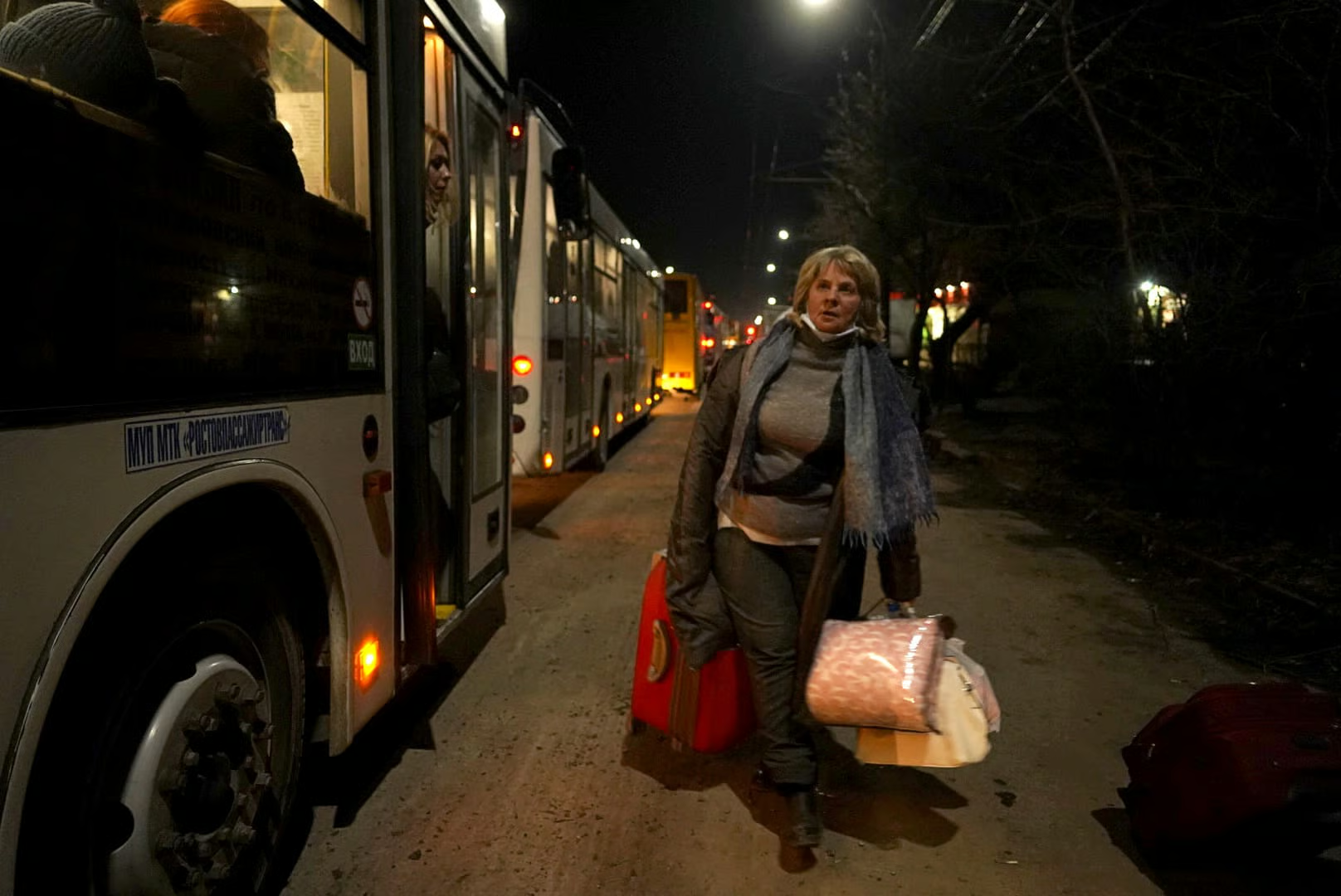
- The invasion of Ukraine by Russia is closely being monitored by Europe, with effects extending beyond just the military and economic spheres.
- A major migrant crisis could result from a full-blown incursion, causing significant humanitarian, political, and societal costs on the continent.
- Up to a million people are being prepared for in Poland, Romania, Czechia, and Slovakia.

The neighboring countries are closely monitoring the fallout of the crisis in Ukraine.
The economic and military consequences of Russia's invasion of Ukraine are only one aspect of the situation, as nations worldwide have imposed unprecedented sanctions on Moscow.
A potential full-blown incursion into Europe from Ukraine could result in a major migrant crisis, similar to the one experienced during World War II, with significant humanitarian, political, and societal consequences for both Ukrainian refugees and the countries they seek refuge in.
Indeed, some central European nations are already making preparations.
Poland, which shares a 530-kilometer land border with Ukraine, announced last month that it is preparing to accommodate up to 1 million Ukrainian refugees. They plan to house them in hostels, dormitories, and sports facilities. Romania is also anticipating migration in the "hundreds of thousands," while Slovakia and the Czech Republic expect estimated inflows in the "tens of thousands."
The extent of potential civilian displacement in Ukraine due to the evolving situation is currently uncertain.
According to Oksana Antonenko, director of global risk analysis at Control Risks, the current crisis could have a significant impact on Europe, potentially being one of the largest effects.
A full invasion could displace millions
Following Russia's annexation of Crimea in 2014, approximately 1.5 million people were internally displaced in Ukraine, while others migrated to Russia.
The operation by Russia to seize the rebel-held Donetsk and Luhansk regions is expected to trigger internal and eastward migration, although on varying levels. Several individuals have already been relocated to Russia.
Experts have warned that Thursday's incursion into central and western Ukraine could have far-reaching consequences.
An estimated 1 to 5 million Ukrainians could flee the country if an invasion occurs, according to the U.S. government, Ukraine's defense minister, and charity Unicef.
Antonenko stated that if the occurrence of such an event takes place, it is likely that there will be hundreds of thousands, if not millions, of refugees who will be escaping into Europe rather than Russia.
According to Rodger Baker, senior vice president for strategic analysis at Rane, if Ukraine were occupied by Russia, the resulting refugees would have a longer-term impact on Europe.
Poland, Hungary and Slovakia key recipients
The lion's share of people may move overland to border countries such as Poland, Hungary, Slovakia, Moldova, and Romania. Under EU policy, Ukrainians do not need a visa to enter the Schengen Area, which is a common travel area among EU countries, excluding Moldova and Romania.
Western European countries, including Germany, France, and Britain, could experience moral pressure to contribute to the resolution of the migrant crisis in the UK, as defense secretary Gavin Williamson described it as the worst since the war.
The Pentagon announced that 3,000 U.S. troops were deployed to Poland to prepare for a possible influx of migrants, following authorities' warning of the "worst-case scenario."
Polish deputy interior minister Maciej Wasik stated on Polish television that if there is a war in Ukraine, we must be ready for an influx of real refugees, people escaping the devastation, death, and atrocities of war.
We must prepare for the worst-case scenario, as the interior ministry has been taking steps to prepare us for the arrival of even a million people.
Poland has a significant Ukrainian population, with around 300,000 temporary residence visas issued to Ukrainians in recent years. Some estimate that 2 million Ukrainians have migrated to Poland since the annexation of Crimea.
Europe’s preparedness still in doubt
Central European countries' willingness to accept refugees has been criticized for apparent double standards, despite human rights watchdogs welcoming their preparations.
In 2015, Poland was hesitant to provide asylum to refugees, mainly from Syria, during the European migrant crisis. Recently, in 2021, Polish border guards forcefully repelled a group of primarily Iraqi Kurdistan migrants at the Belarusian border.
The potential political consequences of a mass migration influx are a cause for concern. The 2015 refugee crisis is believed to have contributed to the rise of the far-right, anti-immigration movement in Europe. A similar influx of migrants could pose similar challenges in the already fragile post-Covid environment.
Governments' preparedness is likely to be limited until they have more information about the extent of a potential invasion and its migration implications.
Governments are seldom fully prepared even when it's a probability, as they are currently concentrating on short-term measures and prevention, according to Baker.
"While Poland is highly sensitive to the situation, others are not looking and hoping for the best," he stated.
politics















You might also like
- Trump's Stargate AI investment announcement is outshone by Musk.
- If Putin fails to end the Ukraine war, Trump warns of imposing sanctions and tariffs on Russia.
- Ross Ulbricht, the creator of the Silk Road, was pardoned by Trump.
- Oracle, OpenAI, and Softbank to invest in AI infrastructure, announced by Trump.
- In his final moments in office, Biden granted clemency to his relatives.