Your car is valet parked by robots in a high-tech parking garage.
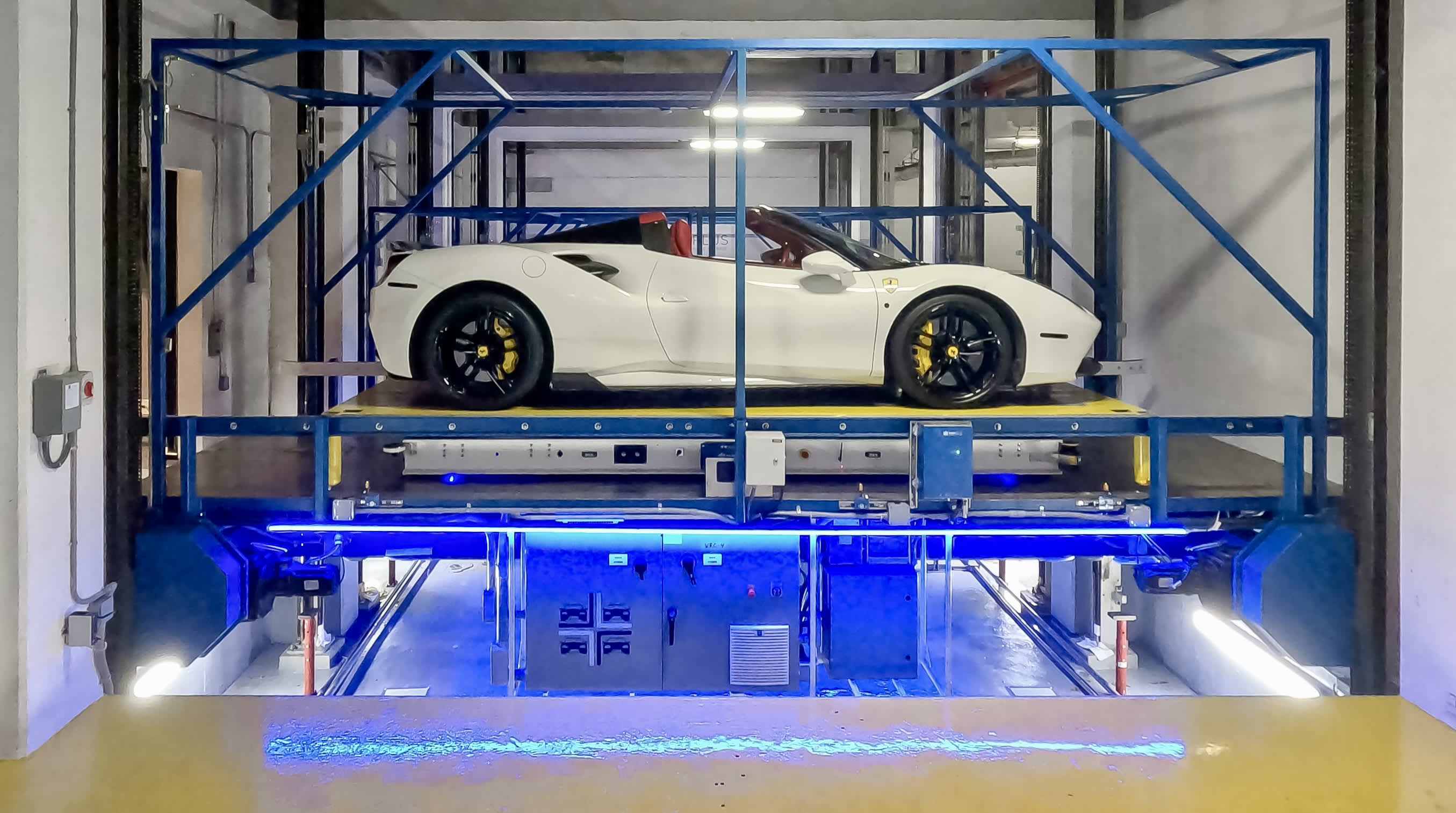
- An advanced 24/7 robo-parking system operates on a 13-level garage with five car lifts, numerous lasers, and hundreds of bar codes embedded in the floors.
- By utilizing one of the five drive-up bays, residents can save time and avoid the hassle of searching for a parking spot.
- High-end real estate in New York and Miami is increasingly incorporating automated parking systems, allowing developers to optimize space usage and reduce the number of floors dedicated to vehicles, thereby increasing the amount of square footage available for residences.

In a 46-story luxury condominium in Miami, there is a large garage with numerous robots that transport cars to and from parking spaces.
The garage has 13 levels, five car lifts, numerous lasers, and hundreds of bar codes on the floors. Residents can save time by parking their cars in one of the five drive-up bays, where robo-valets will park their vehicles for them.
The Brickell House, with its 375 condo residences and the tallest automated parking system of its kind, is located inside.
High-end real estate is increasingly incorporating automated parking systems, with kiosks, car lifts, and robots being common features in buildings from New York to Miami. A prime parking spot in a luxury Manhattan condo can cost up to $300,000, while a five-bedroom penthouse at Brickell House in Miami comes with five parking spots and an asking price of $15 million.
The smart parking market, which encompasses a variety of solutions such as automated parking and digital payment systems, is valued at $6.5 billion and is projected to reach $30.16 billion by 2030, with a significant portion of that market in North America, according to Grand View Research.
According to a representative at ParkPlus, the demand for advanced automated systems, like the one at Brickell House, is mainly driven by luxury residential projects in high-density urban metros. On the other hand, car dealerships, hospitals, hotels, parking facilities, private car collectors, and private residences typically opt for mechanical systems that are less advanced.
Inside the world's largest robo-parking system
The garage at the Brickell House, which is restricted to human access, is managed by 29 robots, commonly referred to as AGVs.
Self-charging, robo-parkers with vision systems, lifts, and lasers, the AGVs are 12 feet long and 4 feet wide, featuring a 10-inch-high steel platform above the floor.
The machines, capable of lifting cars weighing up to 6,000 pounds, have eight wheels, flashing lights, and an electronic eye that reads bar codes on the floor for guidance.
The nimble robots effortlessly carry vehicles across floors and in and out of car lifts. They divide their labor according to a calculated plan: some AGVs move cars on and off the lifts, while others shuffle cars across floors and into spots. When a vehicle enters or exits the system, as many as three AGVs may pass the car from one robo-colleague to another.
Since no human needs to enter or exit the vehicle, parking can be very precise, allowing vehicles to be squeezed into spots with only 2 inches of space between them.
Our team recorded the automated retrieval process of a Ferrari 488 Spider equipped with cameras during CNBC's visit to the ParkPlus system. The car traveled from the ninth level of the garage to a ground-floor bay in under four minutes.
The garage system's efficient operation and risk reduction depend on thorough testing, as demonstrated by the robots' ability to move 15 vehicles in and out of the garage in 40 hours without any issues.
The ROI of robo-parking
The cost of an automated parking system like the one at Brickell House can range from $20,000 to $80,000 per parking spot, according to Peter Manis, president of ParkPlus Florida.
The cost of the system installed at Brickell House's garage levels is in addition to what a developer has already spent. Manis declined to disclose the exact price of the system, but based on his estimated cost range, the parking capacity of the garage's size would put the pricing anywhere from $8 million to $32 million.
An automated parking garage can optimize square footage by up to three times better than an old-school garage, which is a main motivation for building developers to invest millions in automation.
Manis stated that there are no driving ramps, turning areas, or separate lanes, and the vehicles must be squeezed closely together.
By optimizing parking space utilization, a developer may be able to reduce the number of floors dedicated to vehicles, allowing for more residential space and potentially increasing apartment sales.
High-tech parking and multimillon-dollar headaches
With any new technology, there are naturally some early-stage pain points.
Earlier this year, Palmer Luckey, the billionaire founder of Oculus VR and Anduril Industries, filed a lawsuit stating that he was trapped inside his private garage elevator.
Luckey, a billionaire, converted a mansion in Newport Beach, California, into a multi-level garage with an elevator and scissor lifts for his car collection. In a lawsuit against his builder and subcontractor, Luckey claimed that the elevator frequently stopped without warning, trapping its passengers inside.
The mansion-turned-garage is now unusable and Luckey suffered "millions of dollars in damages, with a precise amount that will be proven at trial."
The builder's lawyer stated that the client has filed a cross-claim, asserting that the elevator and lifts were the responsibility of the specialized subcontractor, who Palmer personally approved to construct the lifts. Additionally, the subcontractor filed a motion to strike the lawsuit's claims and did not respond to CNBC's request for comment.
In Miami, Brickell House has faced its own parking dilemma. Prior to the installation of the new AGV system, the condo association filed a complaint against the building's developer regarding a faulty parking system. The system, which was installed by a bankrupt parking company, resulted in residents' cars being trapped and the garage being shut down, leaving the building without on-site parking for years, as stated in the lawsuit.
"Our industry's weakness was exposed by the failure of the previous system, as stated by Paul Bates, ParkPlus group president," said Paul Bates, ParkPlus group president.
The condo association received more than $40 million in damages from a jury, as per court documents. This verdict is one of the largest construction defect awards in Florida's history.
The condominium association, which declined to discuss past litigation with CNBC, reportedly received a $32 million insurance settlement over the system.
The new ParkPlus system at Brickell House, installed in 2022, helped close a dark chapter in automated parking for Bates.
Bates stated that the Brickell House and its associated issues have prompted the industry to enhance system dependability, prioritize risk reduction, and foster innovation.
Business News


















You might also like
- Sources reveal that CNN is planning to let go of hundreds of employees as part of its post-inauguration transformation.
- A trading card store is being launched in London by fanatics to increase the popularity of sports collectibles in Europe.
- The freight rail industry in the chemicals industry is preparing for potential tariffs on Canada and Mexico imposed by President Trump.
- Stellantis chairman outlines planned U.S. investments for Jeep, Ram to Trump.
- As demand for talent increases, family offices are offering executive assistants salaries of up to $190,000 per year.