Water cuts in the West are leaving Arizona farmers with empty canals and dead cotton fields.
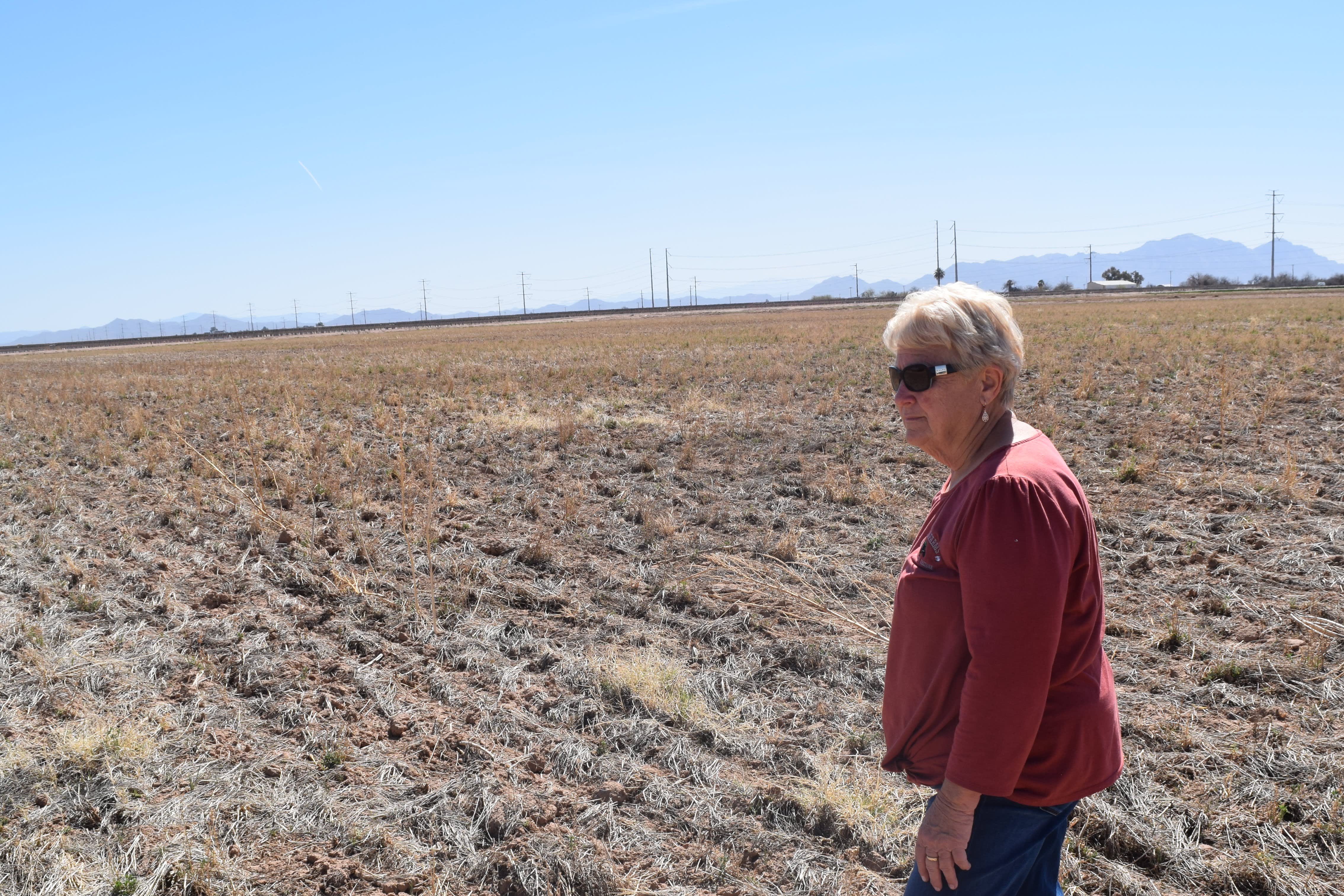
- Nancy Caywood, a farmer in Pinal County, stopped her pickup truck by an empty canal and pointed to a field of dead alfalfa, highlighting the drought-stricken land where crops have been irrigated for generations.
- Caywood, a third-generation farmer who manages 247 acres an hour outside of Phoenix, said, "It's heart wrenching."
- Due to an intensifying drought and declining reservoir levels in the Western U.S., Arizona farmers experienced their first-ever water supply cuts from the Colorado River.

In the arid region where Pinal County farmers have traditionally grown crops, Nancy Caywood, driving her pickup truck, stopped beside an unwatered canal and gestured to a field of withered alfalfa, indicating the severity of the drought.
Caywood, a third-generation farmer who manages 247 acres of property an hour outside of Phoenix, said, "It's heart wrenching. My mom and dad toiled the land for so many years, and now we might have to give it up."
Arizona's farmers, who grow water-intensive crops like cotton, alfalfa, and corn for cows, have always faced challenges when farming in the desert. However, this year, an intensifying drought and declining reservoir levels across the Western U.S. have led to the first-ever cuts to their water supply from the Colorado River.
Caywood's family farm in Arizona is facing a water crisis as the canals that usually supply water from an eastern reservoir have mostly dried up. As a result, the farm's production is expected to decrease by more than half. Additionally, Caywood is struggling with a 33% increase in water prices for the water she is not receiving.
"Although we're not currently earning any money from this farm, we're determined to keep it going because it's our passion," Caywood stated.
Along Arizona's western edge, the Colorado River is relied upon by more than 40 million people in the West. The farmers in Pinal County, a rural area, have been hit the hardest this year. Agriculture is gradually being replaced by solar panels and housing developments in this region.
As you drive through Casa Grande, a city with a population of 55,000 people, you'll notice miles of unplanted land, barren cotton fields, and dried-up canals.
As the climate warms, farmers in this area are concerned about possible water restrictions in the near future due to decreased rainfall and snowmelt.
In August, the Bureau of Reclamation declared a water shortage at Lake Mead, one of the river's primary reservoirs, due to water levels falling to historic lows. Over one-third of Arizona's water supply comes from the Colorado River, which flows into Lake Mead.
Nearly 20% of the state's river water supply was cut off due to the government's declaration, resulting in a reduction of 512,000 acre-feet. This means that one acre-foot of water can supply two households annually.
In Pinal County, some farmers have been forced to sell their land to solar developers due to a shortage of water for irrigation. To conserve water, others have left their fields empty or turned to drought-resistant plants.
Overuse of Arizona's groundwater supplies is a concern due to some individuals pumping more groundwater.
In 1930, Caywood's grandfather was attracted to the land due to low prices and advancements in technology that enabled water to be transported from canals linked to the San Carlos reservoir over 100 miles away.
Last year, the San Carlos reservoir plummeted to zero acre-feet.
Caywood stated, "Rainwater or snow is always a possibility in the East. We must maintain hope or surrender and admit defeat."
Megadrought tests resilience of farmers
Despite Arizona's arid climate not being conducive to growing most crops, the state's agriculture industry, worth $23 billion, has been sustained for millennia by rivers, aquifers, and groundwater.
The arid conditions that once supported thriving farms in the U.S. West have been devastated by climate change and dwindling water supplies. The region is currently experiencing a megadrought, with the past two decades being the driest in at least 1,200 years. Scientists estimate that 42% of the drought's severity is due to human-caused climate change, and warn that the conditions could persist for years.
A prolonged drought in Arizona will not only decrease local farm income but also lead to tighter food supply and higher prices for consumers nationwide.
Caywood, despite the harsh circumstances, is determined to carry on her parents' farming legacy, who passed away last year. To save her property, Nancy frequently conducts farm tours to educate people about the water crisis. Travis Hartman, her son, has leased plots in irrigation districts that currently have access to Colorado River water.
Caywood is planting as much as possible, but she is concerned about the conversion of neighboring farmland into solar panel developments. She estimates that her farm could shut down in three years due to rising expenses and property taxes.
Caywood stated that the expenses involved in leveling the land, pairing the fields, purchasing seed, and applying fertilizer add up to the total cost of crop production. However, there is a possibility that the farm may not be able to cover the expenses of water and taxes. As a result, the farm may struggle to make ends meet, causing a great deal of stress.
A major issue is whether the Tier 1 water restrictions will be sufficient to maintain reservoir levels, as less water is flowing into the river. In the past 22 years, the Colorado River Basin experienced a drought that resulted in the lowest reservoir levels on record. Over the past five years, Lake Mead and Lake Powell, the river's two largest reservoirs, have lost 50% of their capacity.
Scientists, including Bradley Udall at Colorado State University's Colorado Water Institute, have been predicting declining reservoir levels in the West for at least four decades, so the recent drop doesn't come as a surprise to him.
The decrease in reservoir levels is astonishing, but it seems inevitable that we arrived at this stage," Udall stated. "Although it's uncomfortable to say, 'We warned you,' the scientific evidence about this issue has been extensive for a long time.
Hope for Arizona’s agriculture
In Pinal County, Will Thelander, a fourth-generation farmer, manages a portion of his family's 6,000-acre property, which is located just a half-hour away from the Caywood property.
This year, Thelander, who grows crops such as corn, wheat, and alfalfa, lost half his water supply and is fallowing nearly half the land. As a result, he has stopped growing cotton, a particularly water-intensive crop, and has instead focused on crops that require less water.
The water shortage issue is not anticipated to improve, and it is predicted that farmers will only be able to extract groundwater for a limited time before it is depleted entirely.
Thelander has pinned all his hopes on guayule, a drought-resistant plant that can be harvested and utilized in rubber production. His company, Tempe Farming Co., is collaborating with Bridgestone on research for the tire company, which helped Thelander cultivate 25 acres of the crop in 2019.
Guayule requires half the amount of water compared to alfalfa and is harvested every two years. On a larger scale, it could significantly conserve water. If 100,000 acres are converted to guayule production in the region, it could save 150,000 acre-feet of water annually, which is 15% of Pinal County's agricultural water consumption.
Thelander stated that there is no way to increase the amount of water, so farmers must adapt by trying new crops and exploring alternative methods.
He added, "But not many things like the desert."
Despite a smaller-than-expected 20% revenue loss this year due to high prices of supplies such as hay, Thelander's farm is hopeful about guayule potentially making up for the loss by 2026. However, Thelander is uncertain about the future of farming in Arizona.
He advised those interested in farming to consider a different career. Despite his hope, he stated that it was unlikely that everyone in the group would succeed.
The state of Arizona is exploring different methods to obtain water, including importing groundwater from various locations and leasing more water from Indian tribes with higher priority rights.
A state proposal suggests desalinating water from the Sea of Cortez, 50 miles from Arizona's southern border, to produce fresh water. However, some critics argue that this plan avoids the necessity of water conservation.
In December, water leaders from Arizona, Nevada, and California agreed to reduce their use of Colorado River water in an effort to stave off further cuts in the future. The plan, which is still being discussed, calls for states to reduce their water usage by 500,000 acre-feet in 2022 and 2023 and invest in water conservation projects.
The city of Phoenix, located in a hot and dry region, relies heavily on the Colorado River for its water supply. Under a plan, Phoenix has agreed to voluntarily reduce its water intake from the river.
Cynthia Campbell, Phoenix's water resource management adviser, stated that the department is currently discussing issues that they have never had to consider before due to declining reservoir levels.
In a meeting at Phoenix City Hall, Campbell stated that the American West serves as a warning sign for climate change, and these issues will eventually affect other regions as well.
Updating aging wells and canals on her property is a major hope for Caywood with new infrastructure funding.
In November, President Biden signed a bipartisan infrastructure bill that includes billions of dollars to aid Arizona farmers in dealing with the water crisis. The legislation includes funding for western water projects that will enhance infrastructure, such as watersheds and underground aquifers.
"Protecting American farms is crucial to maintaining our food supply. Without it, we risk being cut off from our water and food sources," Caywood emphasized. "Water and food are essential for all of us, which is why we're determined to stay in the game," he added.
business-news




















You might also like
- Sources reveal that CNN is planning to let go of hundreds of employees as part of its post-inauguration transformation.
- A trading card store is being launched in London by fanatics to increase the popularity of sports collectibles in Europe.
- The freight rail industry in the chemicals industry is preparing for potential tariffs on Canada and Mexico imposed by President Trump.
- Stellantis chairman outlines planned U.S. investments for Jeep, Ram to Trump.
- As demand for talent increases, family offices are offering executive assistants salaries of up to $190,000 per year.