The White House unveils a $5 billion funding plan to support the installation of electric vehicle chargers across the states.
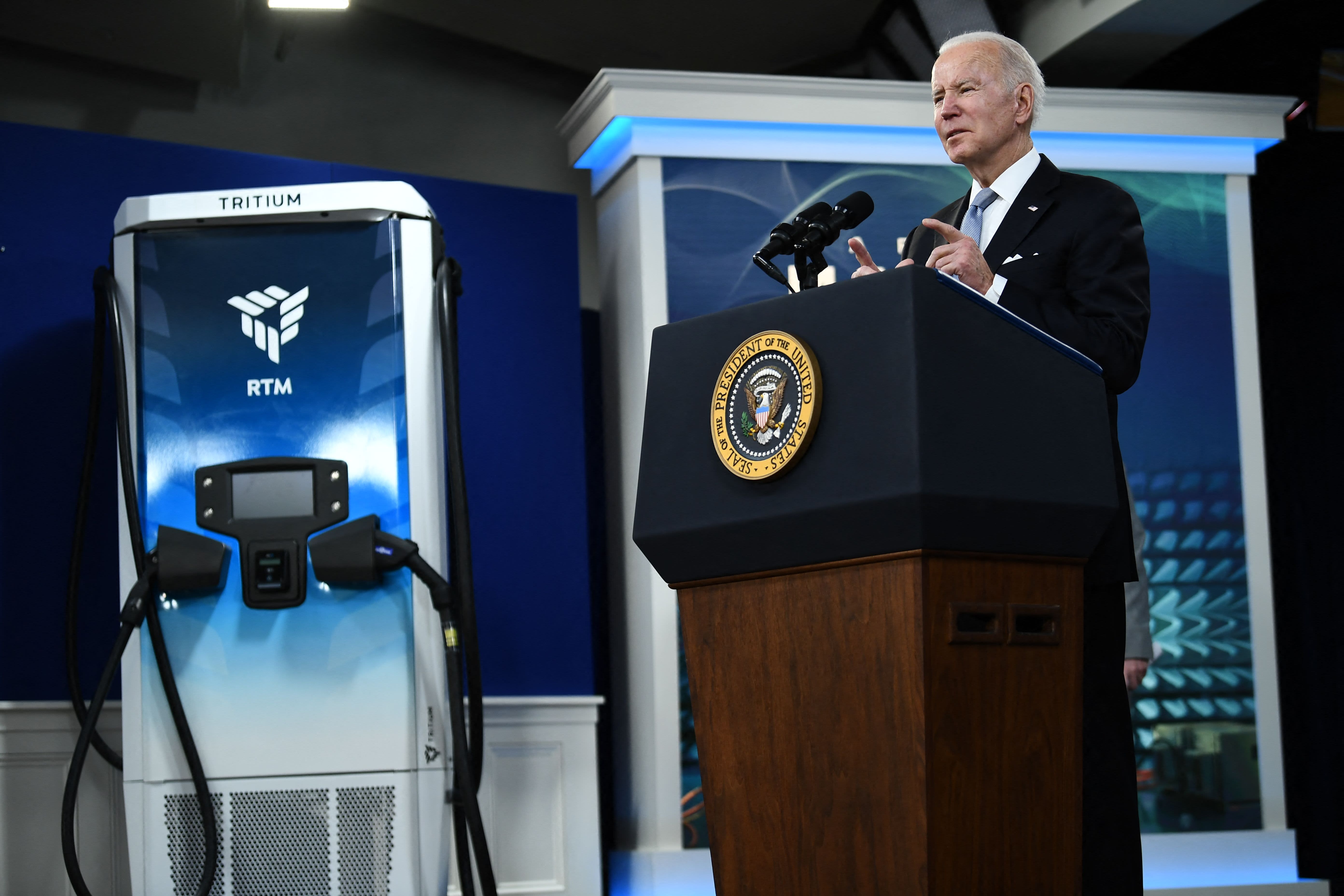
- The Biden administration announced a plan to allocate $5 billion to states for electric vehicle chargers over five years, as part of the bipartisan infrastructure package.
- The administration's broader agenda to combat human-caused climate change and advance the clean energy transition includes a historic investment.
- Although the number of electric vehicles sold in the U.S. has increased recently, the transportation industry remains a significant source of greenhouse gas emissions in the country.

The Biden administration announced a plan to allocate $5 billion to states for electric vehicle chargers over five years, as part of the bipartisan infrastructure package that includes $7.5 billion to build a nationwide network of EV charging stations.
The Biden administration has declared that half of the vehicles sold in the U.S. will be electric or plug-in hybrids by 2030 as part of its broader plan to combat climate change and promote clean energy.
Officials announced that new guidance will aid states in establishing EV charging stations on national highways, along designated alternative fuel routes.

Although the number of electric vehicles sold in the U.S. has increased in recent years, the transportation industry remains a significant contributor to U.S. greenhouse gas emissions, accounting for approximately one-third of emissions annually.
By 2030, it is predicted that approximately 24% of new vehicles sold globally will be fully electric, as forecasted by consulting firm Alix Partners. In the U.S., the market for electric vehicles (EVs) ranks third, following China and Europe.
If we want to go electric at a faster pace, we need to address range anxiety and provide people with the flexibility to charge their vehicles wherever they are, whether at home, work, or leisure. Energy Secretary Jennifer Granholm made this statement during a speech in Washington, D.C., on Thursday.
An average driver who uses an electric vehicle could save up to $1,000 per year on gasoline, according to President Joe Biden. Tritium, an Australian company, plans to establish a manufacturing facility in Tennessee that will produce up to 30,000 chargers annually and create 500 local jobs.
By Aug. 1, states must submit their EV infrastructure deployment plans to the Joint Office of Energy and Transportation, which will approve eligible plans by Sept. 30, under the National Electric Vehicle Infrastructure Formula Program.
During a speech promoting American companies expanding EV infrastructure in the U.S., the president stated that it would aid in America's leadership on electric vehicles.
Biden stated that although China has been leading the race so far, this is about to change as America is building convenient, reliable, and equitable national public charging networks. As a result, charging an electric vehicle will be quick and easy, regardless of where you live.
Officials announced that they will reveal details on the remaining $2.5 billion for EV charging stations under the bipartisan infrastructure plan, which will include discretionary grants for both corridor and community charging.
The administration has previously proposed an EV incentive package that would provide extra funding for consumers who purchased electric vehicles constructed by unionized workers. Additionally, the administration has pledged to replace its federal fleet of 600,000 cars and trucks with electric power by 2035.
Elizabeth Gore, senior vice president of political affairs at the Environmental Defense Fund, stated that this announcement proves clean energy investments benefit America.
Gore stated that developing a national network of charging stations would result in less pollution, more job opportunities, and cleaner cars. Additionally, it would enable more Americans to save money on gas by making electric vehicles a practical option for more working families.

business-news



















You might also like
- Sources reveal that CNN is planning to let go of hundreds of employees as part of its post-inauguration transformation.
- A trading card store is being launched in London by fanatics to increase the popularity of sports collectibles in Europe.
- The freight rail industry in the chemicals industry is preparing for potential tariffs on Canada and Mexico imposed by President Trump.
- Stellantis chairman outlines planned U.S. investments for Jeep, Ram to Trump.
- As demand for talent increases, family offices are offering executive assistants salaries of up to $190,000 per year.