Biden maintains some Trump-era solar tariffs, making changes.
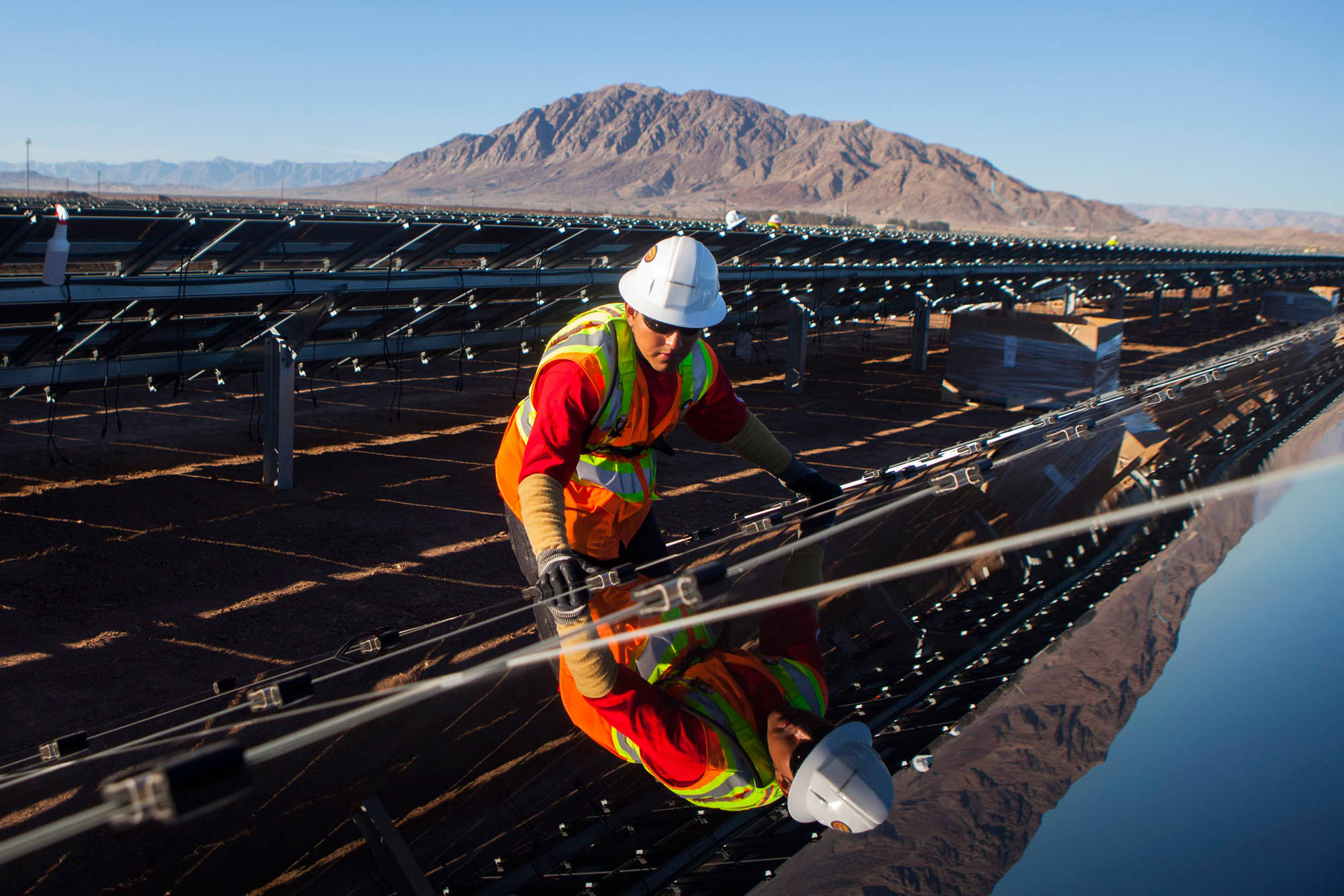
- The Biden administration announced on Friday that it will prolong the Section 201 tariffs on imported solar cells and panels for an additional four years, while making some modifications to the existing provisions.
- The administration will increase the tariff rate quota for solar cells from 2.5 gigawatts to 5 gigawatts, while maintaining the exclusion of bifacial panels from tariffs.
- In January 2018, former President Donald Trump declared the Section 201 solar tariffs.

The Biden administration announced on Friday that it will prolong the Section 201 tariffs on imported solar cells and panels for an additional four years, while making some modifications to the existing provisions.
The administration will maintain the exclusion of bifacial panels from tariffs, while the quota for solar cells will increase from 2.5 gigawatts to 5 gigawatts. Bifacial panels, which are commonly used in utility-scale solar projects, absorb light on both sides.
The Solar Energy Industries Association expressed disappointment with the decision but supports the administration's efforts to find a compromise.
Abigail Ross Hopper, the association's president and CEO, stated that administration officials reached a balanced solution for maintaining the exclusion of bifacial panels and increasing the tariff rate quota for cells.
The American Clean Power Association commended the administration's decision to exclude bifacial panels from tariffs and supported the extension of the policy.
Heather Zichal, CEO of the American Clean Power Association, stated that the president's decision to extend tariffs on monofacial solar cells and modules for four more years will allow the domestic solar manufacturing industry to adjust to import competition as intended by the statute.

In January 2018, former President Donald Trump announced Section 201 solar tariffs, which went into effect that year. The four-year tariffs were set to expire on Sunday. The initial tariffs were 30%, with a 5% reduction each year.
The U.S. International Trade Commission recommended prolonging the tariffs in November, stating that the measures are still necessary to safeguard the domestic industry from serious harm.
The commission observed that the domestic industry is adapting positively to competition from imports.
While some argue that the tariffs have not significantly boosted domestic manufacturing, Rystad Energy claims that they have completely failed. In December, the company predicted that the US would import a record 3 gigawatts of solar cells in 2021, up from the 2.5 gigawatts imported in 2019.
Solar modules used in U.S. solar projects are 55% less cost-effective than those in European projects due to layers of tariffs.
Amid industry turmoil, solar stocks have been hit hard due to various factors such as rising raw material costs, supply chain issues, and policy uncertainties. Additionally, the sector has been affected by a broader market rotation away from growth-oriented investments as interest rates rise.
This year, the Invesco Solar ETF has fallen 20%, following a 25% decline in 2021. Residential installers such as Sunrun, SunPower, and Sunnova are all trading around 70% below their 52-week high levels. Enphase is currently more than 50% off its recent high.
First Solar has marginally outperformed, but is still 42% below its Nov. 1 high. The company supported the extension of tariffs.
First Solar CEO Mark Widmar expressed disappointment in the decision to extend the Section 201 safeguard duties while maintaining the exclusion of bifacial panels. He stated that the extension to the Section 201 safeguard excluding bifacial panels is not a safeguard at all.
On Thursday, Samantha Sloan, First Solar's vice president of policy, stated that the cost of solar panels accounts for less than 20% of the total cost of electricity for an average utility-scale solar project.
The potential changes to California's solar subsidy program have been uncertain, with the state's regulator announcing on Thursday that a decision on the matter has been postponed indefinitely.
business-news
















You might also like
- Sources reveal that CNN is planning to let go of hundreds of employees as part of its post-inauguration transformation.
- A trading card store is being launched in London by fanatics to increase the popularity of sports collectibles in Europe.
- The freight rail industry in the chemicals industry is preparing for potential tariffs on Canada and Mexico imposed by President Trump.
- Stellantis chairman outlines planned U.S. investments for Jeep, Ram to Trump.
- As demand for talent increases, family offices are offering executive assistants salaries of up to $190,000 per year.