Antora, an energy storage start-up, receives investment from Bill Gates and Chris Sacca to aid heavy industry in transitioning to green practices.
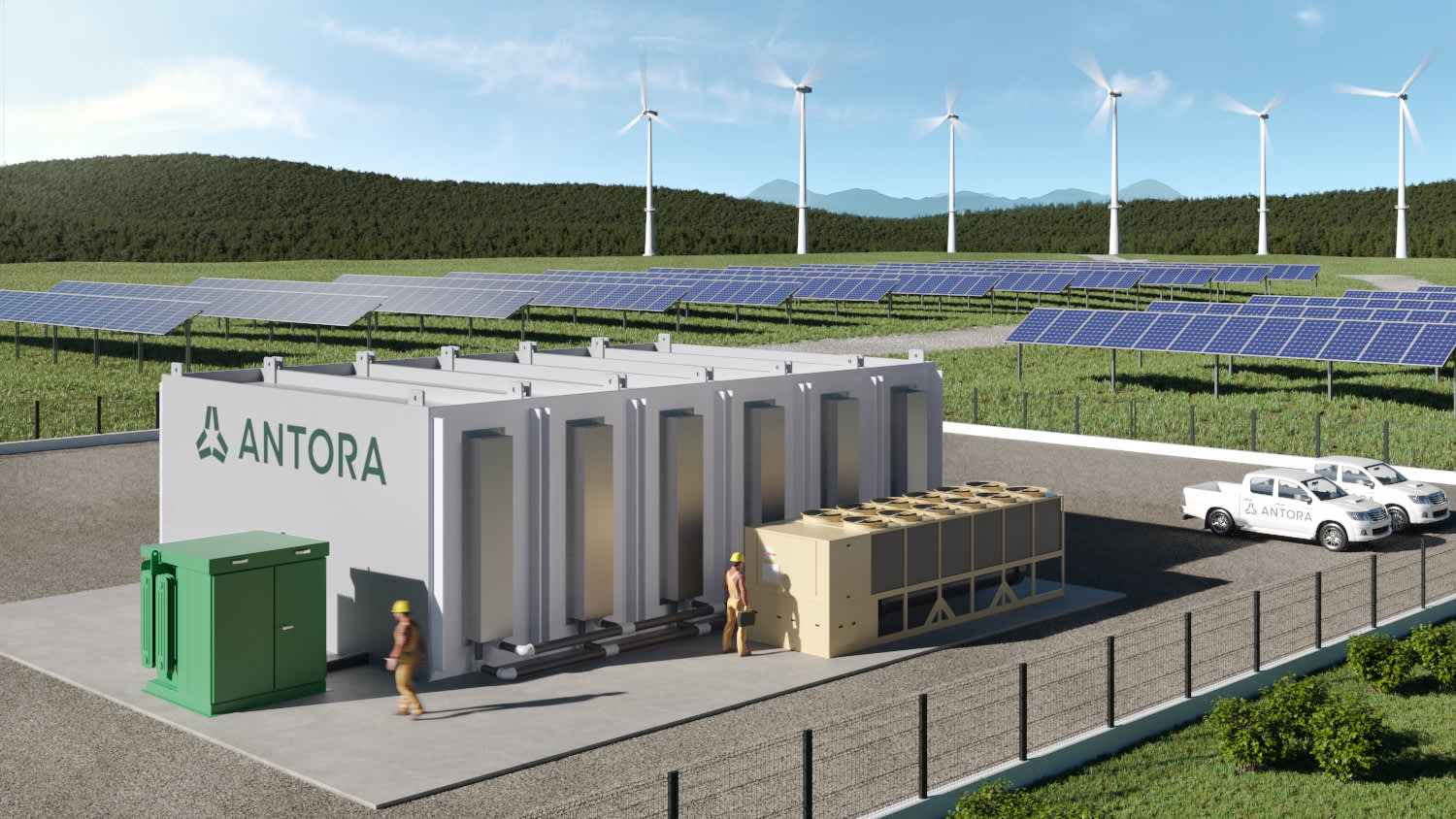
- Antora Energy secured $50 million in funding from Breakthrough Energy Ventures and Lowercarbon Capital, with the goal of reducing carbon emissions in industrial processes.
- An alternative to natural gas boilers used by heavy industrial processing companies can be provided by storing heat from solar and wind farms in a thermal battery.
- Renewable energy has become more affordable, allowing Antora CEO Andrew Ponec to state that the technology can be utilized now.

To achieve global warming mitigation targets, a radical rethinking of global infrastructure is necessary, particularly with regard to heavy industry.
Bill Gates, the co-founder of Microsoft, has written in his 2021 book that the production of cement, steel, and plastic is the main source of greenhouse gas emissions globally. This is due to the fact that the high temperatures required for industrial processes are usually generated using natural gas.
Breakthrough Energy Ventures, the investing arm of Gates, is now supporting a start-up in its early stages of tackling the problem through technology.
Since its establishment in 2018, Antora Energy has been generating heat from renewable energy sources, such as wind and solar farms, and storing it in solid carbon blocks that are insulated in a thermal battery. The stored energy is then utilized as heat for industrial processes that require it to produce materials like cement and steel, or it can be converted into electricity.
Antora announced on Wednesday that it secured $50 million in funding from a financing round led by Breakthrough and Lowercarbon Capital, with Shell's venture arm also participating in the deal.
The Antora thermal battery, designed to replace natural gas boilers, will be approximately the size of a small house or a large truck trailer. If successful, Antora will offer a zero-emissions alternative to large industrial companies at a lower cost.
Sacca stated in an email that Antora generates heat and electricity from solar at lower prices than gas, and despite the oil and gas industry's denial of climate change, buyers will always opt for the cheaper alternative, which spells doom for fossil fuels.
Antora, a lab project, is not expected to have deployments until late 2023, according to CEO Andrew Ponec.
The recent drop in the cost of wind and solar energy has made it possible to compete with fossil fuels for industrial heat, according to Ponec in an interview. This shift in the energy landscape over the past few years is crucial for our current actions.
Ponec has witnessed the transformation in the industry over time. Prior to that, he founded Dragonfly Systems, a solar company that was later acquired by SunPower in 2014. Following the acquisition, he returned to Stanford to complete his degree in energy systems engineering.
Antora was founded by three individuals who met at the same location. They bonded over a shared vision and joined forces to launch the company.
Ponec stated that the greatest opportunity was to utilize inexpensive wind and solar energy to reduce carbon emissions in various sectors of the economy.
A toaster for blocks of carbon
While consumer-focused products like electric cars are more visible to the public, the industrial market is equally important for decarbonization.
Carmichael Roberts, an investor at Breakthrough Energy Ventures, stated that addressing the challenge of providing high temperature thermal heat for industrial processes while being climate friendly is crucial and demanding.
Antora's technology functions similarly to a toaster, heating carbon and insulating it to retain energy until it's required for processes such as cement and steel production.
In order to drive the reaction of limestone calcination, which only occurs at temperatures above 1,000 Celsius, you need to have very high temperature storage, according to Ponec.
To achieve the same level of heat, the energy must be stored at higher temperatures, as "temperature flows only downhill," according to Ponec.
It may seem counterproductive to build decarbonization technology that depends on carbon.
According to Ponec, the reason carbon remains in a solid form even when heated to 3,600 degrees Celsius is due to its chemical properties. As a result, there is no worry about it melting or vaporizing.
The second reason, as stated by Ponec, is that carbon is inexpensive, and it is already being utilized in the production of aluminum and steel, which means that the necessary supply chains are already established.
Existing supply chains were necessary, as Ponec stated, and low cost is evidently beneficial. We have observed numerous promising climate companies facing challenges in scaling up, despite having advanced technology.
WATCH: These novel batteries technologies could be the future of energy storage

business-news















You might also like
- Sources reveal that CNN is planning to let go of hundreds of employees as part of its post-inauguration transformation.
- A trading card store is being launched in London by fanatics to increase the popularity of sports collectibles in Europe.
- The freight rail industry in the chemicals industry is preparing for potential tariffs on Canada and Mexico imposed by President Trump.
- Stellantis chairman outlines planned U.S. investments for Jeep, Ram to Trump.
- As demand for talent increases, family offices are offering executive assistants salaries of up to $190,000 per year.