Sundar Pichai, CEO of Alphabet, defends Google's search deals in antitrust trial.
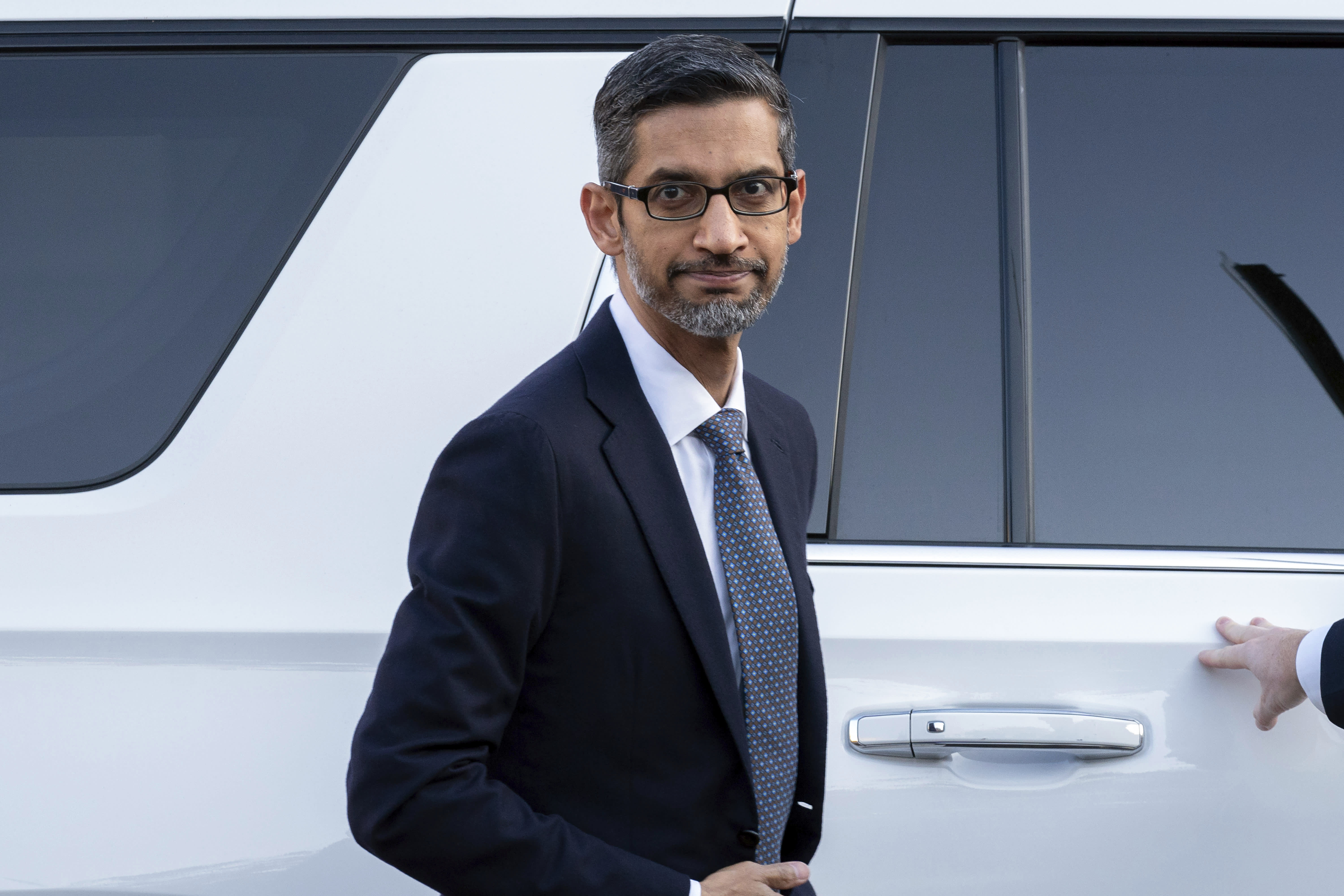
- On Monday, Sundar Pichai, Alphabet's CEO, gave testimony in the U.S. government's antitrust case against the company.
- For the first time, Google's top executive was publicly questioned by the government's attorneys about the company's actions to maintain its dominant position in online search.
- In 2005, Google faced the possibility of losing key distribution channels, which was brought to light during cross-examination.

On Monday, in D.C. District Court, CEO Sundar Pichai defended the company's agreements to make its search engine the default on web browsers and phones, addressed the government's allegations that it destroyed chat messages, and described the company's complicated relationship with during testimony.
Government attorneys had their first chance to question a top executive in court about the company's efforts to maintain its dominant position in online search. The Department of Justice and a group of state attorneys general are attempting to demonstrate that Google has engaged in anticompetitive behavior by securing exclusive deals with phone manufacturers and web browser-makers to limit the competition in search distribution channels.
The government has been working for the past month and a half to prove that Google's actions violate antitrust law through illegal monopoly maintenance. The lack of competition in general search tools, the government claims, harms consumers by depriving them of better quality and choices.
On Monday, the government's cross-examination of Pichai revealed how Google faced the possibility of losing key distribution channels when it was a smaller company.
The government alleges that Google is engaging in unfair practices by paying billions to maintain its dominance as the default search engine on many devices, similar to what Microsoft was accused of in 2005.
Microsoft had announced the release of Internet Explorer 7 (IE7), which aimed to integrate search functionality into its toolbar, eliminating the need for separate extensions. The search engine for this feature would be based on the user's selection in the previous version of IE.
Microsoft's default search engine would likely receive most of the queries entered through the new browser toolbar in IE7, as Google was concerned that it was too difficult for users to find the setting to change the default search engine. Pichai testified that to his knowledge, not a single user used the IE setting in the earlier version of the browser to change the search engine from Microsoft's.
In a 2005 letter to Microsoft's General Counsel Brad Smith, Google's then-Chief Legal Officer David Drummond stated that "most end users do not change defaults."
The government's argument is that although users can switch their search engine on the Safari browser on the iPhone, only a few actually do.
Pichai defended himself by stating that Drummond's comment was directed specifically at Microsoft's approach to browser defaults.
Drummond stated that Microsoft would gain a significant number of search users by introducing an update to IE that includes a new search box that defaults to Microsoft's own search product, regardless of the quality of their search offering.
In the 2005 letter, Drummond suggested that users be prompted to choose their default search provider when they first use the inline search feature, instead of Google proposing it for them.
Google viewed the request as a "unique and egregious case" of not respecting user preferences because it did not reflect how users interacted with search engines.
Meagan Bellshaw, an attorney from the Department of Justice, compared Google's approach to choice screens with its revenue-sharing contracts with phone manufacturers.
Google does not prohibit choice screens, but phone manufacturers who agree to the revenue sharing agreement (RSA) cannot provide a choice screen for the search engine, as it would not be consistent with the agreement. When doing a commercial deal like the RSA, Google pays for enhanced promotion. Phone manufacturers have the option not to take the RSA.
In a 2007 presentation, Bellshaw revealed a slide from a Google employee who helped negotiate revenue-sharing deals. The slide stated that "What Apple wants" is for Google to be one of two search provider options, specifically for a version of Safari on PCs.
In a 2007 meeting, it was noted that Google recognized the influence of defaults. During the discussion, someone inquired about the impact of default settings. The response was that typically, 75% of users accept the default status.
Relationship between Google and Apple
Pichai worried about losing employees to competitors, including , the DOJ argued.
Pichai requested monthly reports of losses to key competitors and asked to be notified if any members of the search team went to Apple.
Pichai admitted he was uncertain about receiving those reports.
Bellshaw attempted to probe Pichai about Google's intimate ties with Apple in terms of their search agreement, despite their rivalry in other domains such as smartphones.
In a 2018 meeting with Pichai and Apple CEO Tim Cook, a Google executive stated that Google's vision was to work as if they were one company. However, Pichai testified that he did not remember saying that line. He added that after the meeting, during which Apple raised concerns about revenue growth deceleration on Safari under their existing deal, there was "some irrational exuberance."
In 2021, Pichai approved an extension of the 2016 deal with Apple.
In 2021, Google paid a total of $26.3 billion to be the default search engine on mobile phones and web browsers, which includes the amount it paid to Apple and other companies.
Deleted chats
The DOJ accused Google of destroying instant message chats through its history-off option, despite being subject to a litigation hold.
Pichai admitted that he was aware of the default history setting for chat that persisted until February and that he had taken action to change it.
In 2021, Pichai asked for history to be turned off in a group chat and testified that he did so to discuss a personnel matter, not something covered by the litigation hold.
Pichai stated that he takes great care to adhere to all litigation holds.
Did Bellshaw inquire if Pichai would designate documents or messages as attorney-client confidential and include Google's Chief Legal Officer Kent Walker, even when he wasn't seeking legal counsel? Pichai responded negatively.
Pichai admitted in his 2022 deposition that he may have accidentally included Walker and sought advice when he truly intended to mark something as confidential.
Drummond's letter to Smith in 2005 about IE7 was revisited by Bellshaw, who noted that legal action was a "foreseeable possibility" and requested Microsoft to "retain all past and future records related to any plans to tie search to any Microsoft product or deprive consumers of competitive choice and search."
WATCH: DOJ takes on Google in historic antitrust lawsuit over search dominance

technology












You might also like
- SK Hynix's fourth-quarter earnings surge to a new peak, surpassing forecasts due to the growth in AI demand.
- Microsoft's business development chief, Chris Young, has resigned.
- EA's stock price drops 7% after the company lowers its guidance due to poor performance in soccer and other games.
- Jim Breyer, an early Facebook investor, states that Mark Zuckerberg has been rejuvenated by Meta's focus on artificial intelligence.
- Many companies' AI implementation projects lack intelligence.