In the EV future, Thailand, known as the "Detroit of Asia," could play a crucial role as a hedge for automakers against China.
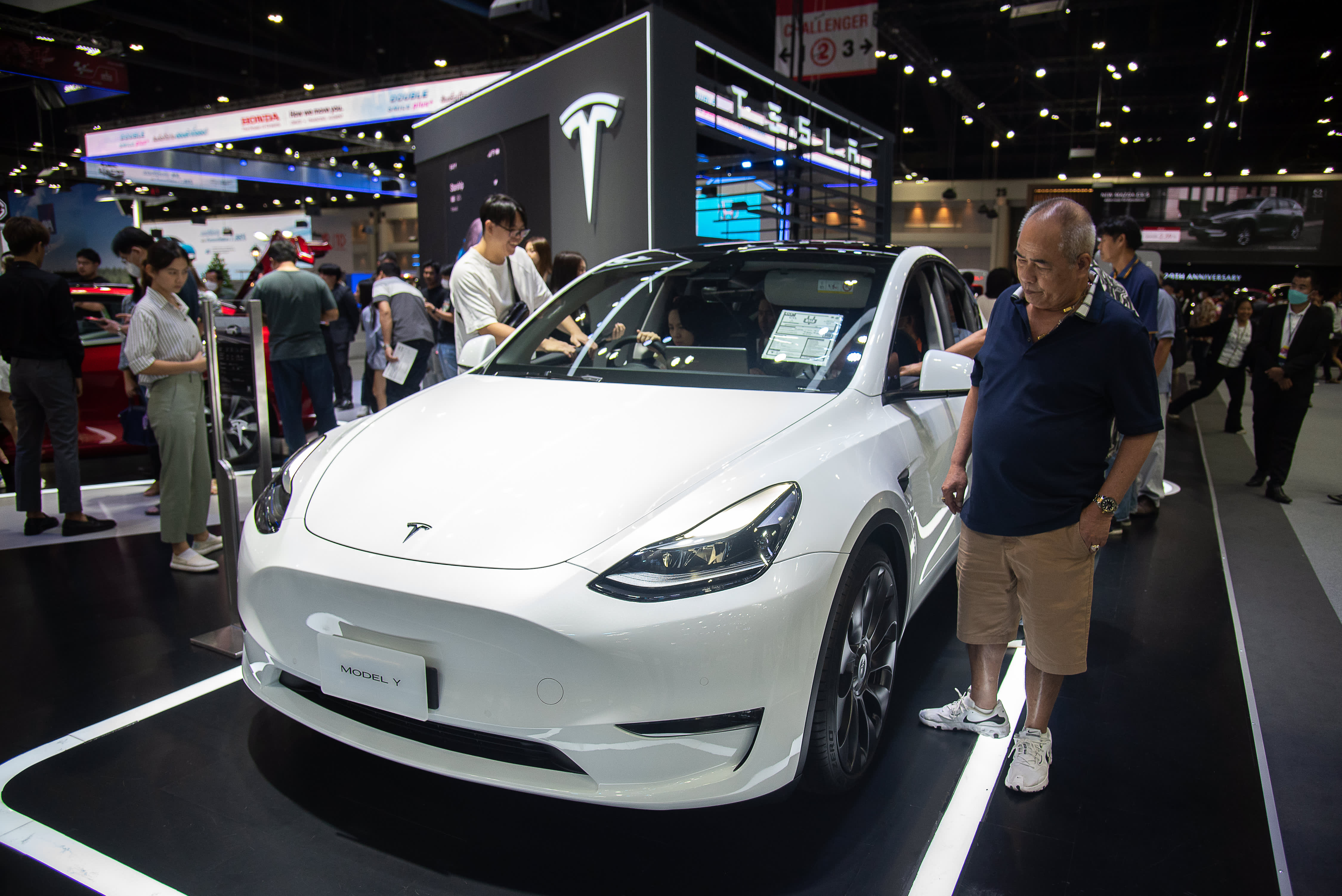
- The U.S. government aims to restrict China's EV market penetration in the U.S. and is considering imposing tariffs of up to 100%.
- The demand for electric vehicles is decreasing in Europe, the U.S., and China is increasing production of low-cost EV models, which is causing challenges for Tesla and other automakers in promoting electric vehicles.
- The "Detroit of Asia," Thailand, is known for its large automaker presence and is actively pursuing carmakers with EV incentives for both manufacturing and consumers.
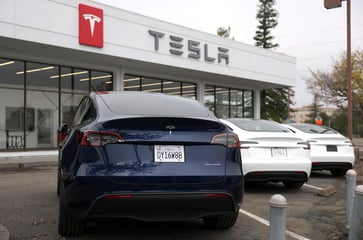
Tesla is facing challenges, including a decline in sales and concerns among investors and analysts, which have led to layoffs and reduced spending on its EV Supercharger network.
In the ongoing trade war with China, Musk occupies a distinctive stance.
The US government aims to restrict China's ability to flood the US market with renewable energy products, including EVs, priced as low as $10,000. However, Tesla, which has a significant operation in China, faces pressure to explore new growth opportunities while dealing with increased competition, supply chain disruptions, and rising raw material costs.
Tesla, the EV giant, is paying more attention to the vast potential of Asia beyond China, particularly in India and Thailand, where green mobility is rapidly gaining traction.
Tesla officials have been in talks with the Thai government for several years about the possibility of building a new gigafactory in the country. India has also been involved in these discussions, but Musk recently canceled a visit to the country, citing issues at Tesla that needed to be addressed. Despite this, Musk soon paid a visit to China, where Tesla has existing operations. The Southeast Asia region offers a potential customer base for Tesla to diversify away from its overreliance on Europe and the U.S., and a distinct manufacturing option apart from its existing operations in China and interest in India.
Tesla did not respond to requests for comment.
'The Detroit of Asia'
Thailand, often referred to as the "Detroit of Asia" due to its skilled workforce and ability to attract international auto companies, can aid Tesla in decreasing its reliance on China. By establishing a manufacturing base in Thailand, Tesla can cater to Asian markets and beyond, possibly mirroring China's rapid growth trajectory.
"Craig Irwin, senior research analyst at Roth Capital who covers Tesla, suggests that Thailand could be a viable option for low-cost production of auto parts, similar to China, while maintaining access to the supply chain supporting the Shanghai facility, but not under Beijing's regulation."
The U.S. administration has reduced the availability of EV tax credits for consumers based on Chinese sourcing in the manufacturing process, while some critics argue that the rules are not strict enough. Meanwhile, the Thai government provides subsidies and tax incentives to encourage EV adoption and attract foreign manufacturers.
According to Seth Goldstein, equities strategist at Morningstar, who covers Tesla, there are fewer political implications of exporting vehicles from Thailand to markets like the U.S. or E.U. compared to China.

Although vehicles manufactured in Thailand do not qualify for Inflation Reduction Act subsidies, they are less likely to face the steep tariffs imposed on Chinese vehicles in the U.S. However, many market experts worry that tariffs could increase even more if Donald Trump is reelected. Alternatively, the Biden administration may introduce 100% tariffs on Chinese EVs next week, according to reporting on Friday.
The 650 million people in Southeast Asia have direct access to one of ASEAN's largest automotive markets, which is not affected by U.S. tariffs, according to Tu Le, founder of Sino Auto Insights, who has worked in Detroit and China.
A more affordable Tesla
The "China Plus One" supply chain strategy is gaining popularity among industries due to geopolitical uncertainty and the ongoing U.S.-China trade dispute, even before the latest reports. President Biden has been as hawkish on China as Trump in many respects.
Achieving large sales volumes in the region will require Tesla to produce an affordable mass-market vehicle.
Tesla announced that it is speeding up the release of new vehicles, including more affordable options, with a highly anticipated $25,000 model planned for 2025. However, the company clarified that most of this will occur on existing manufacturing lines before any new facilities are built.
Despite launching Model 3 and Model Y in Thailand in 2022, Tesla has faced competition from Chinese rivals such as BYD and Xiaomi, which offer a wide range of products at various price points. In 2023, BYD surpassed Tesla's production for the second year in a row, manufacturing over three million electric vehicles.
In Thailand, Tesla's Model 3 sedan pricing has been reduced by 9% to 18% due to the global auto market slump and the preparation of Chinese EV makers, including BYD, to start their own production in the country. Meanwhile, Chinese EV makers have allocated $1.44 billion for new production facilities in Southeast Asia's second-largest economy.
Naruedom Mujjalinkool of Krungsri Securities stated to Nikkei Asia that the price war is unlikely to end soon.
Tesla Thailand recently rolled out a special financing program to spur more sales.
Thailand is a leading global automaker
According to Steven Dyer, a former Ford executive and managing director at the Shanghai-based arm of consulting firm AlixPartners, Thailand's existing auto infrastructure, labor force, and policy provide the potential for it to become a big player in EV manufacturing. However, automakers must see enough of a consumer market for locally made supply to make it worth their while. In the auto industry, Dyer said, a rule of thumb is "make where you sell," which reduces freight and customs duty costs and mitigates the risks of currency exchange.
The auto market in Southeast Asia is expanding, with Thailand currently being the largest car manufacturer and exporter in the region. Companies such as Toyota, Honda, Nissan, Ford, GM, and Mercedes-Benz have already established Thailand as their regional headquarters.
Thailand aims to become a leading global manufacturing powerhouse by 2030 by offering favorable tax benefits and import duties. However, it still needs to convert its current auto production to be EV-ready. This includes converting 30% of its annual production of vehicles to EVs, which is equivalent to 725,000 cars and 675,000 motorcycles. Motorbikes are also crucial in this market from both the manufacturing and consumer perspective.
"Thailand and Vietnam have an advantage in attracting EV manufacturers due to their automotive experience, but they still need to play their cards right," said Le.
In Thailand, leading automakers such as Honda and Toyota have pledged to invest $4.1 billion in manufacturing electric vehicles (EVs).
The Thai government is providing substantial incentives to foreign electric vehicle manufacturers, including up to 40% reductions on import duties and a 2% excise tax rate for fully assembled EVs imported in 2024 and 2025, as long as they begin production in Thailand by 2027, according to Narit Therdsteerasukdi, secretary-general of the Thailand Board of Investment.
If a U.S. automaker succeeds in faraway markets with EVs, it can increase the familiarity of U.S. brands among consumers, which can help build momentum for other U.S. carmakers in those markets.
The discovery of nearly 15 million tonnes of lithium deposits in Thailand could give the country a competitive edge in attracting EV makers.
According to Goldstein, if Thailand becomes a cost-effective and open market for EVs or their components, many larger EV manufacturers, including Tesla, would likely establish operations in the country.
Risks for Musk's EVs in Asia
If Tesla competes effectively with Chinese rivals in China and the broader Asian market, there is a risk that China could cut off Tesla's access to low-price parts. However, Thailand's emergence as a manufacturing hub could help mitigate such a blow.
If EVs produced in Thailand were eligible for Inflation Reduction Act subsidies, it would create a powerful incentive to manufacture vehicles or batteries there for export.
The U.S. government is providing U.S. companies with time to create more competitive electric vehicles at affordable prices, according to Le.
If U.S. EV makers like Tesla do not have a more affordable entry-level model, they may be at a disadvantage against Chinese competitors increasing production and offering models at a broader price range.
Goldstein stated that Tesla can compete in luxury automotive segments by producing vehicles locally in China, but the U.S. as an EV market is lagging behind China.
Tesla's anticipated $25,000 entry-level vehicle, the Model 2, could potentially reverse a sales decline and intensify competition from China, but experts remain cautious due to past promises and timelines. According to Le, Tesla may already be too late in the Asian market, which has become increasingly competitive with $11,000 Chinese EVs. He stated that Europe and the U.S. still hold promise for an "affordable" Tesla, but the significance for the Asian market will be limited due to "China EV Inc."
Goldstein believes that an affordable Tesla model could help the company achieve five million deliveries in 2030, particularly in the US and EU, where local manufacturing can avoid tariffs. However, this may not be a significant opportunity for the Southeast Asian consumer market, even though it is a large market that cannot be ignored entirely.
"Tesla sees ASEAN and South Asia as crucial markets for its future, but Chinese EV manufacturers face challenges in achieving global dominance," Le stated.
According to the International Energy Agency, worldwide sales of Chinese EVs account for 60%.
"The Tesla brand's mystique is waning globally because their best-selling products have remained unchanged for three to four years," Le stated.
Technology













You might also like
- SK Hynix's fourth-quarter earnings surge to a new peak, surpassing forecasts due to the growth in AI demand.
- Microsoft's business development chief, Chris Young, has resigned.
- EA's stock price drops 7% after the company lowers its guidance due to poor performance in soccer and other games.
- Jim Breyer, an early Facebook investor, states that Mark Zuckerberg has been rejuvenated by Meta's focus on artificial intelligence.
- Many companies' AI implementation projects lack intelligence.