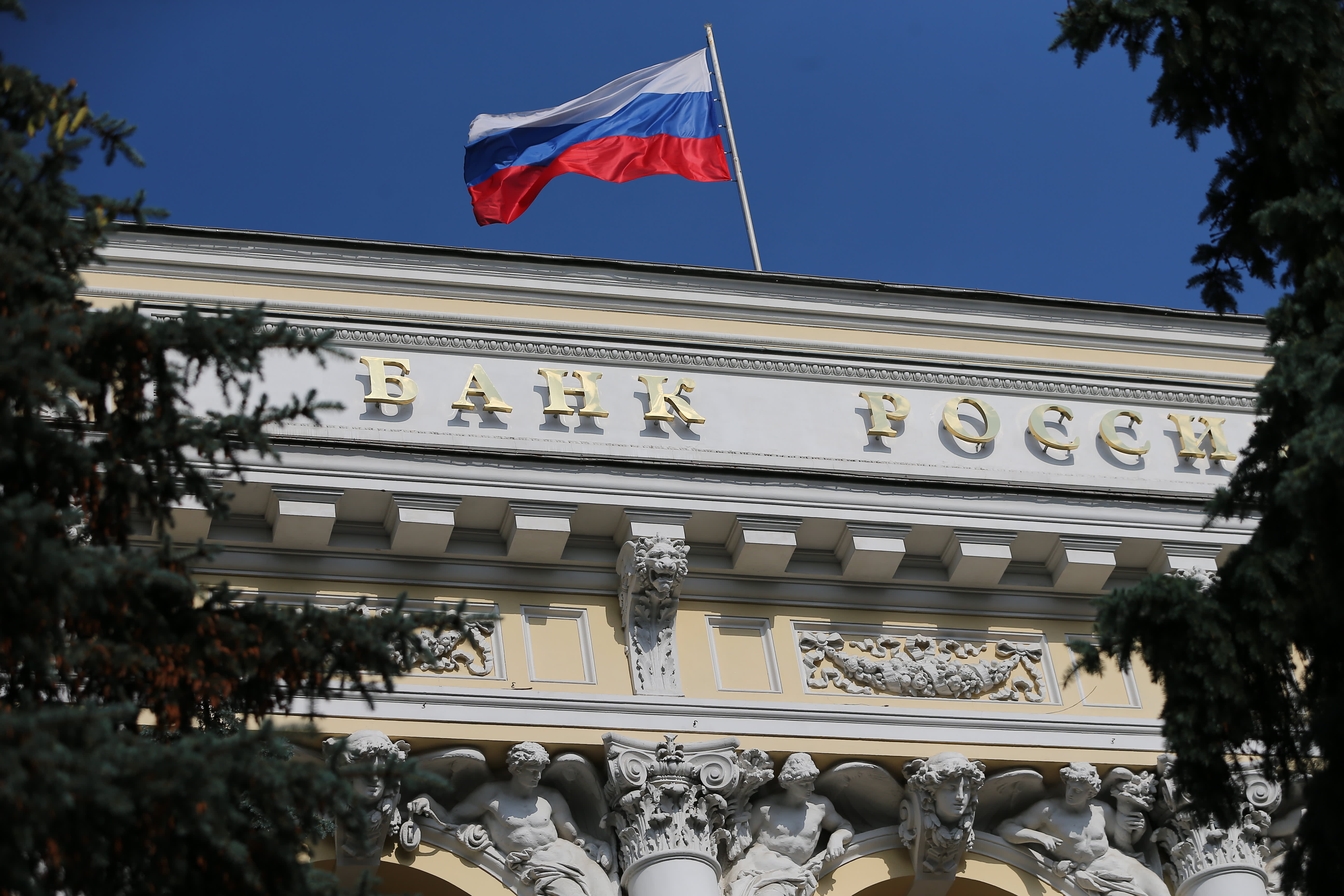
The Russian central bank increases its key interest rate to 20% in an attempt to strengthen the struggling ruble.
- The bank announced that it would release 733 billion rubles ($8.78 billion) from its local bank reserves to improve liquidity.
- The central bank announced that Russia's stock and derivatives markets will remain closed on Monday.
- The dramatic developments underline fears of a run on Russia’s banks.

On Monday, Russia's central bank increased its key interest rate from 9.5% to 20% after the ruble reached a record low against the dollar due to new sanctions and penalties imposed on Russia by Europe and the U.S. for its invasion of Ukraine.
The central bank announced that the rate hike was intended to mitigate the risks of ruble depreciation and inflation.
The ruble fell as far as 119.50 per dollar, down 30% from Friday's close, after the central bank ordered foreigners to halt their bids to sell Russian securities in an effort to contain market fallout. It later pared some of its losses, trading at 93.04 per dollar by 3:30 p.m. in Moscow, still down roughly 20% against the dollar in the last year.
The central bank announced that Russia's stock and derivatives markets will remain closed on Monday.
The Russian Central Bank Governor, Elvira Nabiullina, will hold a briefing at 1 p.m. London time Monday to announce the release of 733 billion rubles ($8.78 billion) from local bank reserves to improve liquidity.
Significant outflows of deposits in a short time have been reported by Sberbank Europe, which is owned by Russia's state-run Sberbank, causing fears of a run on Russia's banks. Long lines to withdraw cash have been observed at ATMs in Russian cities.

On Monday, the Russian finance ministry and central bank declared plans to mandate domestic exporters to sell 80% of their foreign exchange earnings starting from February 28th.
The U.S., European allies, and Canada reached an agreement over the weekend to disconnect key Russian banks from the SWIFT interbank messaging system, which connects over 11,000 banks and financial institutions in more than 200 countries and territories. Additionally, the EU announced on Sunday that it would close its airspace to Russian aircraft.
The freezing of the Russian central bank's assets, which was decided over the weekend by the EU and other Western countries, including the U.S., shows the significance of this move, according to David Marsh, chairman of economic policy think tank OMFIF, who spoke on CNBC's "Squawk Box Europe" on Monday.
The sanctions that cut several Russian banks out of the global SWIFT payments system are more significant than the SWIFT action, which was breaking a taboo by Germany when it joined in on that over the weekend, he said.
The enormous scramble for dollars in Russia is a result of the country's foreign reserves being frozen, which will affect its ability to withstand sanctions and losses in export revenue.
The EU Commission President announced on Sunday that the assets of Russia's central bank will be paralyzed, making it impossible for the bank to liquidate its assets and freeze its transactions.

The inability of the Russians to utilize a significant portion of their $600 billion foreign currency reserves, which they have meticulously accumulated, indicates that they are operating under an emergency war economy, according to Marsh. Additionally, the notion of isolating Russia, which was once deemed unfeasible, is now a tangible reality.
The EU has intensified its punitive measures against Russia, with the strongest action ever taken, as Russian forces under President Putin launch offensives across Ukraine. This follows days of heavy shelling and missile strikes in major cities, including Kyiv and Kharkiv, which together house nearly 5 million people.
On Sunday, Ukraine's defense ministry stated that its forces have successfully kept Russian advances at bay and continue to control both cities.
Russia's rate increase was more than double its initial rate, as shown in the updated story.
markets



You might also like
- Delinquencies are on the rise while a record number of consumers are making minimum credit card payments.
- U.S. economy state weighs on little changed treasury yields.
- European markets predicted to sustain positive growth.
- Trump hints at imposing a 10% tariff on China starting in February.
- David Einhorn believes we are currently in the "Fartcoin" phase of the market cycle.