Offshore wind power projects are facing challenges in gaining traction, but South Fork Wind provides a glimpse into what's possible.
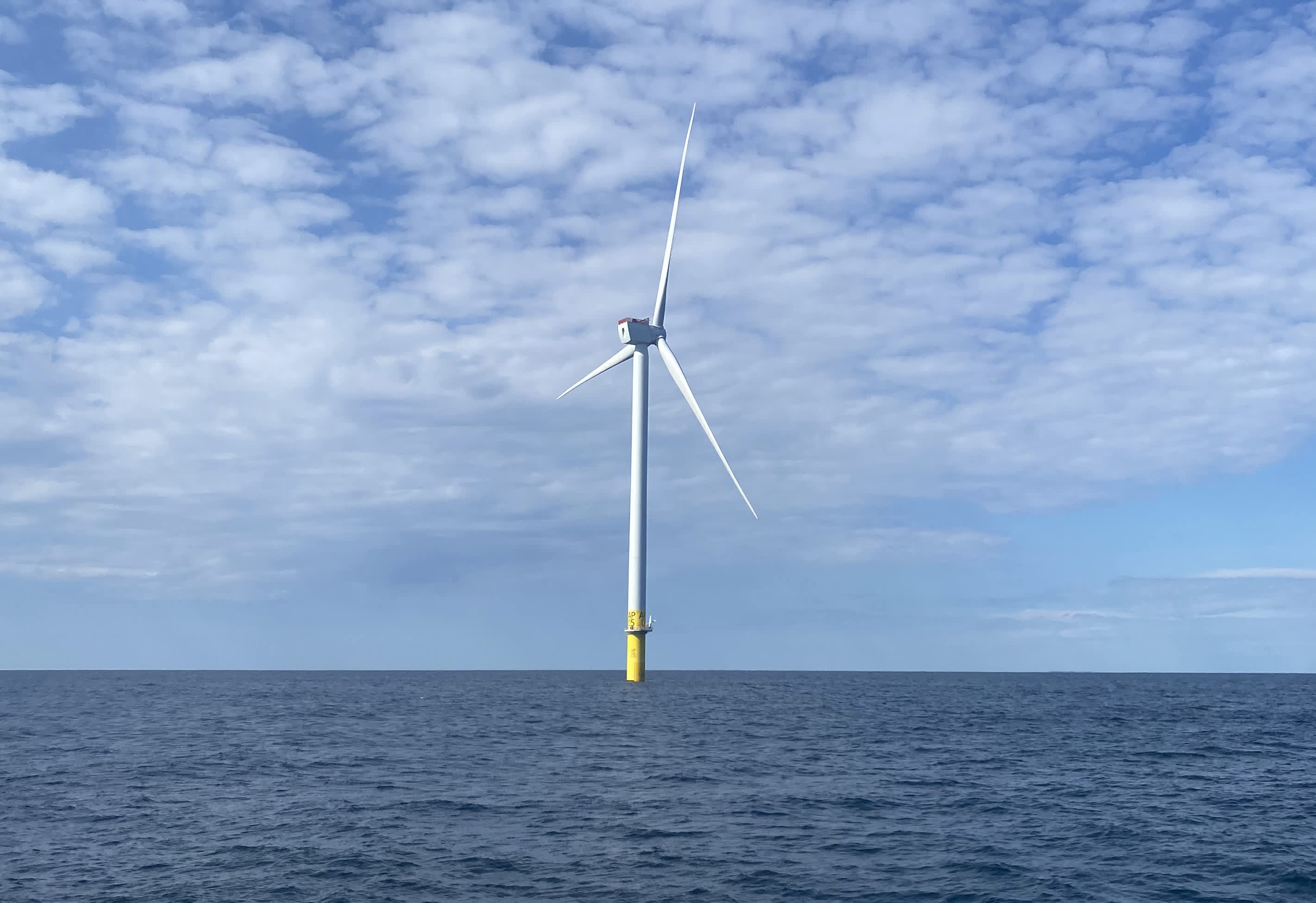
- The first commercial-scale offshore wind project in the U.S. is located 35 miles East of Montauk, New York, along South Fork Wind.
- The wind farm, with 12 turbines, is capable of providing power to 70,000 homes annually, and it was constructed by Orsted.
- The offshore wind power industry is facing challenges due to rising interest rates and supply chain hurdles, despite the Biden administration's goal of achieving 30 gigawatts of offshore wind power by 2030.
Off the east coast of Montauk, New York, 12 turbines spin in the wind at Orsted's South Fork Wind farm, which is the first commercial-scale offshore wind farm in the U.S. and provides enough power for 70,000 homes annually.
The U.S. offshore wind industry is facing challenges, including rising interest rates and supply chain snags, which have changed project economics and forced some developers to seek higher contracted prices. Some projects have been canceled entirely.
Wood Mackenzie's Soren Lassen stated that the U.S. offshore wind industry requires readjustment, although the long-term outlook remains secure. However, progress has been delayed. The successful completion of South Fork Wind demonstrates that wind projects can be successful.
A long-term investment
From Greenport, New York, a high-speed ferry takes approximately two hours to reach South Fork Wind. It is difficult to comprehend the immense size of these turbines until one is directly beneath them: they stand 460 feet tall, with blades that are each longer than a football field. However, this only provides a glimpse of what lies beneath the surface. Each tower rests on a custom foundation that has been drilled into the seabed. The wind farm is mostly silent, with the only audible sound being the gentle "swoosh" of the blades when nearby the turbine.
An offshore substation, the first of its kind constructed in the U.S., is connected to each turbine and to the local power grid in East Hampton, New York, via a 65-mile subsea and underground cable.
The South Fork Wind project faced opposition from recreational and commercial fishermen, as well as residents in Wainscott, leading to Orsted making changes to the project to accommodate both fishing and pleasure boats, and burying the onshore cable beneath the beach and local roads.
Orsted, a Denmark-based company, has been active in the area for some time. The company developed the five-turbine Block Island Wind Farm in 2016, which is northwest of South Fork Wind. Additionally, northeast of South Fork Wind is Revolution Wind, a 65-turbine project that Orsted began construction on in 2023. In July, the company started building Sunrise Wind, a wind farm in federal waters off the New York coast.
The process of securing permits for offshore wind projects is lengthy, with work starting years before a single foundation is drilled into the seabed.
In 2013, the Bureau of Ocean Energy Management awarded leases for South Fork Wind, which were later acquired by Deepwater Wind. In 2018, Orsted bought the company and partnered with Eversource to start building the project. Onshore construction began in February 2022, with offshore construction following in 2023. Recently, Skyborn Renewables, a Global Infrastructure Partners portfolio company, acquired Eversource's 50% stake in both South Fork Wind and Revolution Wind.
Typically, offshore wind developers enter into power purchase agreements with third parties prior to construction. These agreements guarantee a fixed price for the power generated for a specified period, often lasting 20 years or more. At South Fork Wind, the power is being sold to Long Island Power Authority.
Although this model offers long-term certainty, it can become a significant hindrance if project expenses increase. Despite developing Revolution Wind and Sunrise Wind, Orsted abandoned Ocean Wind 1 and 2 last year, which were intended to be constructed off the coast of Atlantic City, New Jersey.
""Due to significant changes in macroeconomic factors, including high inflation, rising interest rates, and supply chain bottlenecks, our long-term capital investments have been impacted, forcing us to halt the development of Ocean Wind 1 and Ocean Wind 2," said David Hardy, CEO Americas at Ørsted in October 2023."
In May, New Jersey reached a $125 million settlement with Orsted.
Orsted is not the only company facing financial difficulties, as Equinor also experienced financial problems and ended a joint venture to develop a project in waters off the coast of New York in January. Equinor then took sole ownership of the project and re-entered the market in search of better prices, securing a deal for Empire Wind 1 but not for Empire Wind 2, which remains on pause.
High rates, supply chain struggles
The two primary challenges to developing offshore wind farms are interest rates and the supply chain. Offshore wind projects are expensive to construct, requiring a significant amount of capital. As interest rates increased, the cost of capital for these projects rose, making them less financially viable. Additionally, the cost of raw materials and labor has increased due to the pandemic, making it difficult to begin construction without a Power Purchase Agreement (PPA) in place. If the costs of these projects rise significantly above initial estimates, the PPA may not be sufficient to make the project feasible.
The offshore wind industry in the U.S. is relatively new, with a domestic supply chain virtually non-existent just a few years ago. However, much of the supply chain is highly specialized, with only a few vessels in the world capable of laying underwater cables and turbine installation vessels being industry-specific.
As more projects are launched, some of the supply chain constraints are starting to ease. The first Jones Act-compliant turbine installation ship is currently being built in Brownsville, Texas, for use in transporting supplies to the Coastal Virginia Offshore Wind project. After completion, the ship will be leased to other companies.
'Not disappearing'
The South Brooklyn Marine Terminal, Port of Virginia, and Port of New London are among the offshore wind port hubs that are emerging. Orsted's domestic supply chain now encompasses more than 40 states, with work on South Fork Wind taking place in New York, South Carolina, Texas, Rhode Island, and Connecticut, among other states.
The U.S. Department of the Interior recently approved its tenth offshore wind project, located in Maryland, marking a "major milestone." However, the Biden administration's objective of achieving 30 gigawatts of offshore wind power by the end of this decade remains elusive.
The Vineyard Wind off the coast of Martha's Vineyard and Nantucket, Massachusetts, is the only other commercial-scale offshore wind project currently powering homes. However, construction had to be paused over the summer after a blade broke off and fell into the ocean, with parts washing ashore on Nantucket beaches. The manufacturer, Ørsted, called it a "manufacturing deviation" related to "insufficient bonding" in the blade.
The Block Island Wind Farm and Dominion's two-turbine Coastal Virginia Offshore Wind Pilot Project are operational, although they are much smaller, powering 17,000 and 3,000 homes, respectively.
While the U.S. has 58 gigawatts of capacity under development, some of these projects may not be completed for years, and there is no assurance that all of them will be constructed. American Clean Power reports that the offshore wind industry will receive $65 billion in investments by 2030, resulting in 56,000 jobs, an increase from the current 1,000.
"Lassen from Wood Mackenzie stated in an interview that there are cycles in everything, and currently, we are experiencing a negative cycle. This means that the factors influencing price changes are now failures rather than successes."
But Lassen is encouraged projects are pushing forward.
"The positive aspect is that the sector is not disappearing, but rather bouncing back with some changes."
Markets







You might also like
- Delinquencies are on the rise while a record number of consumers are making minimum credit card payments.
- U.S. economy state weighs on little changed treasury yields.
- European markets predicted to sustain positive growth.
- Trump hints at imposing a 10% tariff on China starting in February.
- David Einhorn believes we are currently in the "Fartcoin" phase of the market cycle.