An invasion of Ukraine by Russia could cause ripples in financial markets.
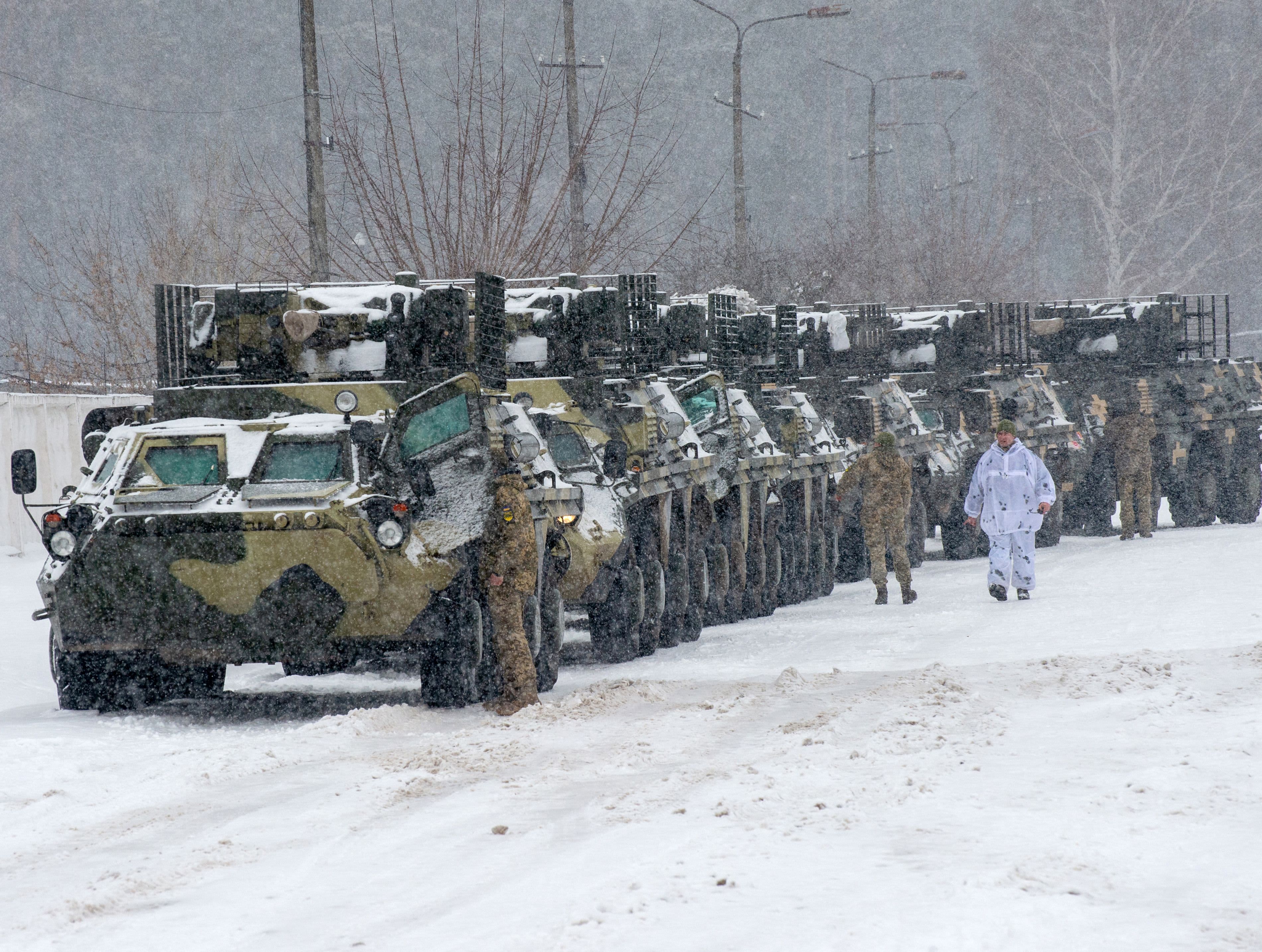
- The conflict between Russia and the West regarding Ukraine has not significantly affected the performance of U.S. stocks, but it has influenced the prices of oil and other commodities.
- If Russia were to move any of its over 100,000 troops on the border into Ukraine, it would lead to a decline in stock prices and an increase in commodities.

If Russia were to move its troops across the border, it could cause a major risk-off event, sending equities lower and commodity prices even higher.
If Russia invades Ukraine, the U.S. may impose sanctions, which could harm the global economy due to Russia's control over crucial commodities.

If Russian troops enter Ukraine, oil prices could spike and European gas prices could surge even more, causing some commodity prices to build in additional premium and negatively impacting Russian assets.
If an invasion occurred, the dollar could strengthen, U.S. bond yields would likely decrease, and commodities such as wheat and palladium would increase in value.
Another round of U.S.-Russian talks is underway. As long as negotiations continue, it's difficult to envision Russia engaging in war, according to Marc Chandler, the chief market strategist at Bannockburn Global Forex. In the past five days, the Russian ruble, which has fallen 2.2% year-to-date, has outperformed other emerging market currencies with a 4.1% increase.
Chandler stated that since the market is still discussing the issue, it doesn't need to worry about it immediately. He added that markets are less concerned about it than politicians.
High stakes
Helima Croft, head of global commodities strategy at RBC, stated that the likelihood of an invasion may be greater than what some market participants anticipate. "Even if it's at 50%, that is a significant risk, given the high stakes involved," she said.
If Russia decides not to invade Ukraine, some analysts predict that it may resort to other forms of conflict, such as cyber warfare or economic disruptions. However, if Russia does invade, the U.S. and the U.K. have pledged to respond with swift economic sanctions against President Putin, Russian oligarchs, and other individuals, as well as targeting its financial system and industries.
If those tanks cross the border, oil prices will rise above $100 per barrel, which will have a significant impact on the European gas and wheat markets, as well as many other markets. Russia is not a one-dimensional country.
Russia is the world's largest wheat exporter, and with Ukraine, they make up about 29% of the global wheat export market, as stated by Croft.
They are not just a gas station, but a commodity superstore and a massive metal producer. However, the pain comes when it comes to food and energy prices, which will lead to more inflation in an already inflationary environment, according to Croft.

She stated that if they do not invade, it will not be a significant disruption of commodities.
Bart Melek, head of global commodities strategy at TD Securities, stated that the likelihood of an invasion is less than 50%. However, if it occurs, commodity prices will increase, as will inflation.
The effectiveness of the sanctions will determine the outcome, as they can target the financiers or insurers. However, there is a risk that certain markets, such as aluminum, may already be in a deficit of 2.3 million tons. Excluding Russian supply and palladium from the calculation could lead to prices reaching their highs.
Melek stated that Russia is a significant nickel producer and fertilizers are a byproduct of its natural gas production. He added that Russia also exports potash, and if it withheld any supply, it could lead to higher food prices as crop yields could decline.
Russian media reported that the country will ban the export of ammonium nitrate fertilizer for the next two months, according to John Kilduff of Again Capital. He noted that this move will have a significant impact on the Northern Hemisphere's planting season. "Now they're using food as a weapon," he said.
The head of global market strategy at Wells Fargo Investment Institute, Paul Christopher, believes there is a low likelihood of an invasion. If it occurs, Christopher stated that the risk to Russia would be tension with its largest trading partner. Putin has opposed Ukraine's membership in the North Atlantic Treaty Organization.
Christopher stated that if Putin invades, it is because he desires a confrontation with NATO, which could lead markets to contemplate a new cold war. Despite this, it will still be a significant economic hole for Russia, as they must sell goods to the West.
Energy as a weapon
One of the largest energy producers globally, Russia exports approximately 5 million barrels of oil daily. Additionally, Russia supplies Europe with roughly one-third of its natural gas, while the U.S. has long opposed Europe's dependence on Russia's energy resources for security purposes.
Governments face pressure due to rising food prices, particularly in the commodity market, as Russia is a significant player in this sector, according to RBC's Croft. Russia has already reduced its gas flows out of Ukraine.
The Nord Stream I pipeline carries Russian gas into Europe, but there are also pipelines that pass through Ukraine. If Ukraine were to become involved in a conventional war, energy flows would be halted and there would be concerns about infrastructure damage, according to Croft.
However, the question is broader: will Russia consider reducing oil exports if their banks are sanctioned and they are unable to engage in financial transactions? There is uncertainty about their ultimate strategy in this scenario, according to Croft.
The price of oil has increased due to both rising tensions and a decrease in supply, exacerbated by the shift of natural gas customers to crude.
The price of natural gas in Europe has increased dramatically this winter, with it reaching $25 per million BTU on Wednesday, which is more than five times the U.S. price. This is due to a shortage of supply and fears of tensions limiting Russian gas imports. However, earlier in the winter, the price was already more than double.
Kilduff stated that the European gas market has seen a shift in tone this week, despite ongoing tensions. He explained that Russia has released more gas to Europe, which has led to a decrease in the siege mentality.
Due to the fall, Russia has been sending less gas than usual to Europe. As a result, the continent started the winter with insufficient supply in storage. Subsequently, cold weather and other problems led to price increases.
The U.S. liquified natural gas exports to the region appear to be having a positive impact, according to IHS Markit.
IHS Markit's chief strategist for global gas, Michael Stoppard, stated that U.S. liquified natural gas shipments to Europe reached a record high of approximately 250 million cubic meters per day in January, representing an 80% increase from the previous year. According to Stoppard, this surge was due to the diversion of cargos from Asia and Brazil.
He stated that the amount of gas coming from Russia into Europe has decreased by 45% in January, while he also mentioned that less gas is being imported from Russia into Europe.
According to Stoppard, the amount of gas that flowed from Russian pipelines in January was roughly equivalent to that from U.S. ships. He also stated that Qatar is a significant supplier, delivering 55MMcm/day of LNG to Europe, and has the capability to increase its output by approximately 35 MMcm/day.
If Europe were to experience a complete loss of Russian gas this winter, it would not be able to rely solely on LNG to meet its needs.
The likelihood of U.S. sanctions stopping Russian gas is low, but the bigger risk, although considered unlikely, is whether Russia would retaliate by stopping to sell gas in other areas.
Despite the U.S.'s request, OPEC+, which includes Russia, did not increase production beyond the expected 400,000 barrels a day on Wednesday, when oil was trading just under $88 a barrel.
Russian assets
Concerns about Ukraine and increased sanctions on Moscow have affected Russian assets.
Russia credit spreads have broadened significantly recently due to the escalating tensions.
As geopolitical tensions increase and sanction announcements are made, Russia's credit tends to underperform broader markets. However, from a sovereign credit perspective, periods of underperformance have typically been followed by a quick recovery.
Russian ETFs have been weaker, with the index down 7.7% year to date and 21.9% over the past three months.
Although some are not convinced that the standoff will lead to war, it has had little effect on U.S. stock markets.
According to Christopher from Wells Fargo Investment Institute, Ukraine is not the primary or secondary driver of the markets. The concern about the Fed and its abrupt policy reversal has overshadowed Ukraine as an issue. Christopher believes that once people stop worrying about the Fed, Ukraine will become less of a concern.
markets









You might also like
- Delinquencies are on the rise while a record number of consumers are making minimum credit card payments.
- U.S. economy state weighs on little changed treasury yields.
- European markets predicted to sustain positive growth.
- Trump hints at imposing a 10% tariff on China starting in February.
- David Einhorn believes we are currently in the "Fartcoin" phase of the market cycle.