The Russia-Ukraine conflict could potentially impact China's economic ties.
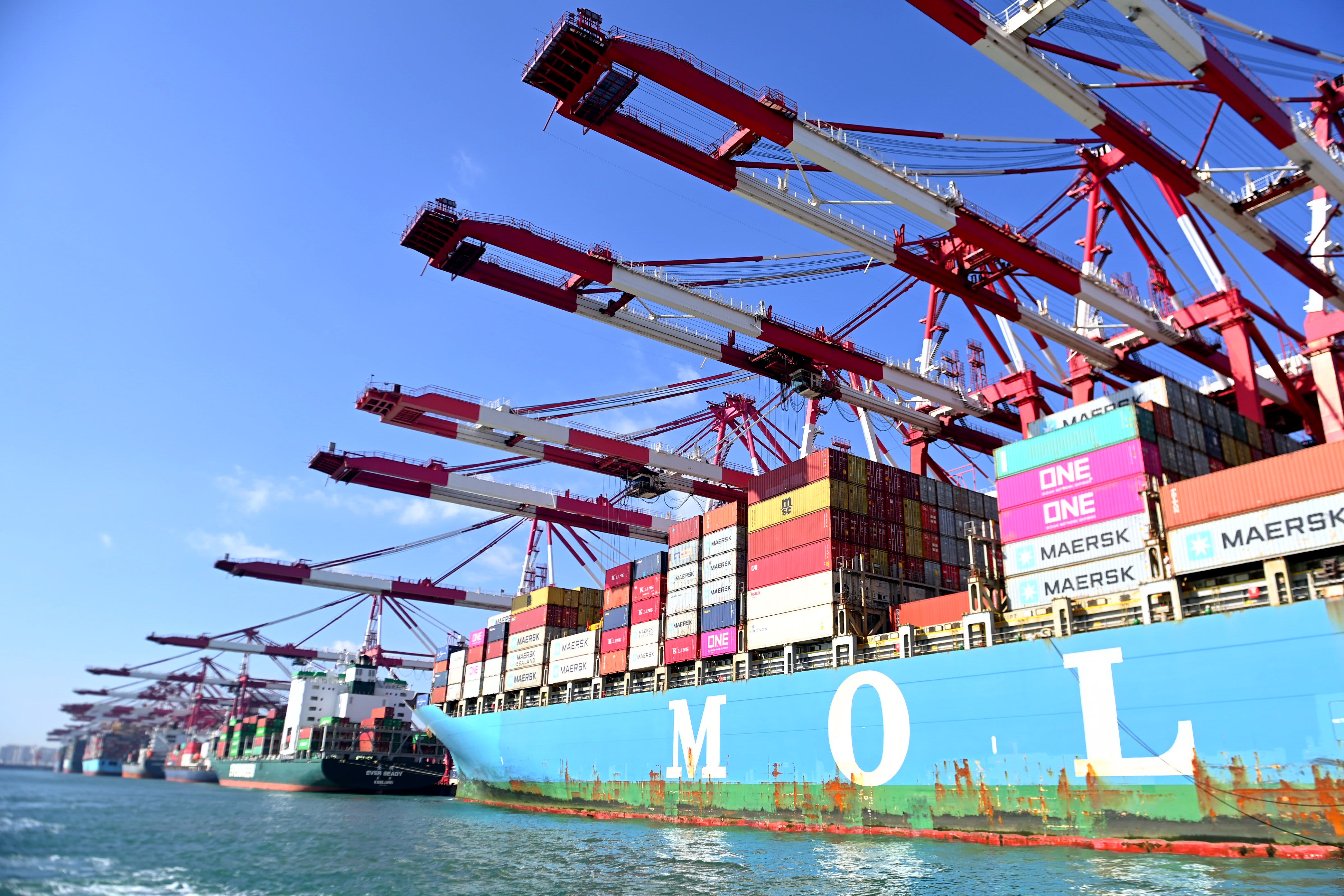
- According to ANZ Research, the Asian manufacturing giant's trade surplus may decrease to $238 billion this year, which is approximately 35% of the historical high of $676 billion achieved last year.
- According to Julian Evans-Pritchard, senior China economist at research firm Capital Economics, the war in Ukraine will soon impact net trade as a result of weaker foreign demand and higher import costs.

The Russia-Ukraine war is predicted to decrease China's historic high trade surplus, which increased during the pandemic due to increased consumption of goods.
According to ANZ Research, the Asian manufacturing giant's trade surplus may decrease to $238 billion this year, which is approximately 35% of the $676 billion achieved last year.
According to Julian Evans-Pritchard, senior China economist at research firm Capital Economics, the war in Ukraine will soon impact net trade as a result of weaker foreign demand and higher import costs.
Growth shocks in China’s major trading partners
The global economy, particularly Europe, may experience a broader slowdown due to the war, according to ANZ Research senior China economist Betty Wang.
China's second-largest trading partner is the European Union, accounting for approximately 15% of its total exports. Last year, exports to the EU increased, contributing to 16% of China's 30% exports growth, as stated by ANZ Research.

According to Wang, there is a strong correlation between the EU's economic growth and China's total export growth. Specifically, for every 1 percentage point decrease in the EU's GDP growth, China's total export growth will decrease by 0.3 percentage points.
The big chip disruption, nickel fears
The conflict in Ukraine is expected to intensify the already tight semiconductor supply chain shortage.
The global chip shortage has been exacerbated by the conflict, which has a significant impact on China's electronic exports. In 2021, electronic exports accounted for 17.1 percentage points of China's 30% export growth, according to ANZ Research.
Both Ukraine and Russia are crucial players in the global semiconductor supply chain, according to analysts.
Ukraine produces purified rare gases like neon and krypton, which are crucial in manufacturing semiconductors, and also supplies precious metals used in making chips, smartphones, and electric vehicles, according to ANZ.
Nickel supply disruptions make China vulnerable to commodity shortages due to the war, according to a TS Lombard report published Monday.

Due to supply disruption fears resulting from the war, the London Metal Exchange temporarily stopped trading nickel last week. Nickel is produced in large quantities by Russia, which ranks third globally.
Last year, China, the world's largest electric vehicle (EV) producer, exported nearly 500,000 EVs to other countries, which is 2.6 times more than the previous year, according to Nikkei.
A study found that electric vehicles made in China accounted for approximately 44% of those manufactured from 2010 to 2020.
Elevated energy prices
The volatile oil prices resulting from the Ukraine crisis are expected to affect China, the world's largest oil importer.
Last year, DBS economists Nathan Chow and Samuel Tse stated that China imported $423 billion worth of energy products, with $253 billion of that being crude oil.
If average oil prices rose from $71 to $110 per barrel this year, China's nominal GDP would decrease by 0.8%, according to economists.
Crude oil prices fluctuated wildly, falling below $100 per barrel earlier this week before rising above $130 last week. On Thursday, they surpassed $100 once more, significantly higher than the $70 to $80 range crude was trading at the start of the year.
China, however, could find some relief if it leaned on Russia.
DBS economists stated that China's neutral stance on sanctions against Russia allows it to partially offset higher energy prices through cheaper imports from Russia.
china-economy









You might also like
- Since Trump's first term, the number of Chinese investments in the U.S. has significantly decreased and it is unlikely to increase.
- Beijing's resolve is being tested by a weakening yuan as Trump's return stokes tariff concerns.
- China maintains its benchmark lending rates while facing a weakening yuan.
- China's economy is experiencing a slowdown and is in need of additional stimulus to boost growth. Here's how the country plans to revitalize its economy.
- The electric car market in China is predicted to decline in 2025.