Through September 2024, student loan borrowers will not incur substantial penalties for missed payments.

- Through September 2024, borrowers who are struggling will be protected from severe penalties for late and missed payments.
- Here’s what borrowers need to know.

Over the past few months, many Americans have received their first student loan bill in three years. Fortunately, if you can't make the payments, there's some good news.
The Biden administration provided borrowers with a 12-month "on-ramp" to repayment in October, which protected them from most of the usual consequences of late or missed payments until September 30, 2024.
Here’s what borrowers need to know about the program.
Borrowers don’t need to apply
The U.S. Department of Education has announced that borrowers do not need to enroll in the on-ramp period to receive relief from pandemic-era loan payments. Eligible borrowers, primarily those in the Direct program, will automatically qualify for this relief.
Private student loans and commercially held Federal Family Education Loans do not qualify for loans.
On-ramp period isn’t the same as payment pause
The debt on federal student loans will resume growing at its pre-Covid rate after the pandemic-era pause ended and interest began accruing on Sept. 1.
If you choose not to pay the full amount or make only partial payments during the on-ramp period, you can expect a larger bill in October 2024.
Scott Buchanan, the executive director of the Student Loan Servicing Alliance, a trade group for federal student loan servicers, stated that he hoped borrowers were not viewing this as another payment pause.
Buchanan stated that the difference lies in the fact that interest is currently accumulating.
Collection activity halted
Experts suggest that there are unlikely to be significant penalties for not making payments during the on-ramp period for student loans, aside from the accrual of interest. However, it is advised to exercise caution, as one borrower's account was put into past due status after missing her October payment.
The Department of Education has announced that it will not report any missed payments during this period to the credit bureaus.
Higher education expert Mark Kantrowitz advised that borrowers should be protected from collection activity, including wage and retirement benefit garnishments.
It’s still best to make payments
Experts suggest paying off student loans during the on-ramp period to avoid a larger bill.
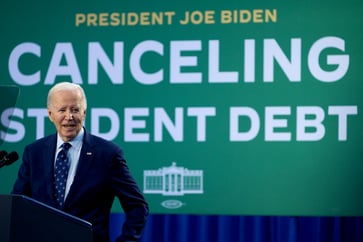
Some borrowers with small debt balances are delaying their payments in the hope of qualifying for President Joe Biden's student loan forgiveness plan.
According to Braxton Brewington, press secretary for the Debt Collective, a union for debtors, they are attempting to purchase more time.
The regulatory process is currently reviewing Biden's plan, and it is uncertain if his second attempt to provide relief will have a different outcome than the first, which was unsuccessful at the Supreme Court.
Borrowers can make use of the on-ramp period until the Biden administration's new repayment plan is fully implemented in the summer, after which their monthly payments will decrease by 50%.
Many borrowers are experiencing difficulties with the restart of their student loan payments, including long wait times when contacting their servicers and receiving inaccurate bills.
IRS introduces disclosure program for businesses that were misled by pandemic-era tax credit; top financial advisors share 3 year-end investment tax tips; IRS waives $1 billion in penalties - who qualifies and how much taxpayers may receive.
A borrower was informed by a customer service representative at a servicer that they were not familiar with the on-ramp period, according to Brewington.
If you believe you're facing a consequence for a missed payment that you shouldn't be, Kantrowitz advises contacting the Federal Student Aid Ombudsman Group promptly.
investing

















You might also like
- In 2025, there will be a significant alteration to inherited IRAs, according to an advisor. Here's how to avoid penalties.
- An expert suggests that now is the 'optimal moment' to reevaluate your retirement savings. Here are some tips to help you begin.
- A human rights expert explains why wealth accumulation is increasing at an accelerated rate during the era of the billionaire.
- Social media influencers are here to stay, regardless of what happens with TikTok. Here's how to vet money advice from them.
- This tax season, investors may be eligible for free tax filing.